
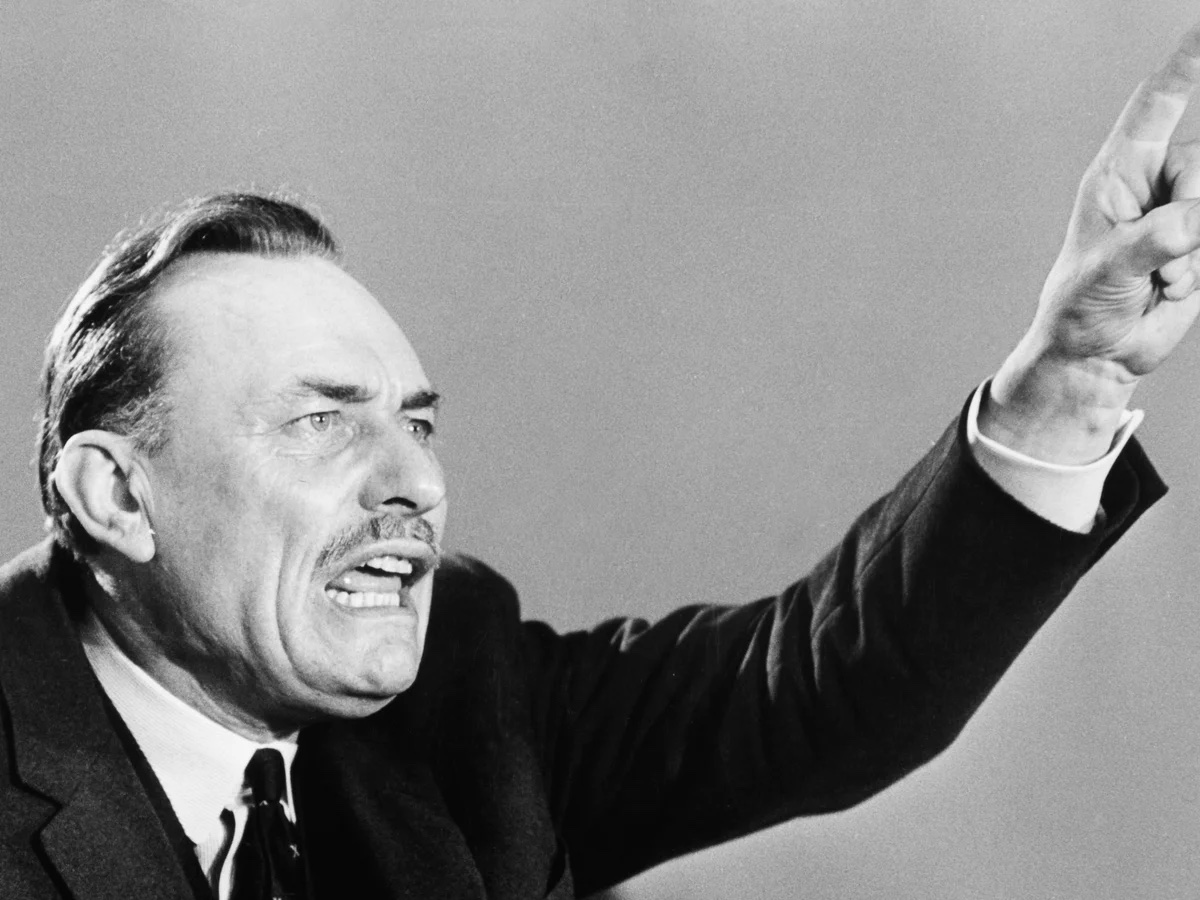

Unfairly but inevitably, the popular revolt against mass immigration and the multiracial society is associated (in the minds of any citizen with political literacy or historical knowledge) with the name of Enoch Powell and his famous speech in Birmingham on 20th April 1968 that warned Britons were becoming “strangers in their own country”.
A classical scholar, Powell referred to the Sibylline prophecy in the great epic Aeneid by the Roman poet Virgil:
“Like the Roman, I seem to see the River Tiber foaming with much blood.”
In our largely postliterate society, this has come to be known as Powell’s “rivers of blood speech”.
In fact, other voices than Powell’s had been raised much earlier against multiracialism. Most notably Sir Oswald Mosley and his Union Movement campaigned on this issue for well over a decade before Powell started to speak out.
Nevertheless it was Powell who ignited a storm of public outrage and stirred up a populist challenge to the political establishment that wasn’t equalled until Brexit.

With Reform UK leader Nigel Farage often described as a ‘Powellite’, and Tory frontbencher Robert Jenrick using Powellite rhetoric as he builds his imminent challenge to Conservative Party leader Kemi Badenoch, it’s instructive to look back at primary sources from 1968 to discover how government ministers privately reacted to Powell’s speech.
Then as now, there was a Labour government with a three-figure majority. The two-party system in 1968 was much more solid than today, and although the National Front had just been created the previous year, it was to prove a lot more difficult for the NF to make an electoral breakthrough by comparison to Reform, which in 2025 is challenging a party structure that has already been crumbling for years.
Enoch Powell had been a Conservative MP since 1950 and served as a minister during 1957-58 and 1960-63 under Tory Prime Minister Harold Macmillan.
His second period in office was as Minister of Health, and as such he was personally responsible for recruiting large numbers of NHS workers from the West Indies. Powell was not what his enemies would call a ‘racist’ or what we would call a racial nationalist. He was a maverick who resigned as a junior Treasury minister in 1958 over economic policy, and in 1963 left the cabinet because he didn’t like his party’s choice of leader. His dismissal from the shadow cabinet in 1968 was the third and last time within less than ten years that Powell left his party’s front bench – clearly not a ‘team player’, quite aside from his views on race and immigration.
Moreover he was in some ways a liberal critic of Britain’s late imperial era. In 1959 (as a backbencher) he criticised his own government in a parliamentary speech on the so-called “Hola massacre” at an internment camp in the then British colony of Kenya, where eleven Mau Mau terrorists were killed in controversial circumstances.
When refusing to join Sir Alec Douglas-Home’s new Tory government in 1963, Powell implied that it was Douglas-Home who was an old-fashioned racist imperialist, while Powell himself was too liberal to associate with such people:
“How can I serve under a man whose views on Africa are positively Portuguese?”
(Powell was here comparing his own Tory leader to the Portuguese empire and Estado Novo dictatorship of Salazar. Yet less than five years later Powell himself was to become – alongside George Wallace – the most notorious ‘racist’ in the English-speaking world!)

In 1963, Powell was closely associated with the most liberal and ‘anti-racist’ of prominent Tories, the former Colonial Secretary Iain Macleod. Yet by 1968 he was at the opposite wing of the party, and following his famous 20th April speech Powell and his old friend Macleod never spoke to each other again. Powell was shadow defence minister in the Tory frontbench team, but was sacked by party leader Edward Heath a day after his speech and was eventually forced out of the Conservative Party, ending his parliamentary career as an Ulster Unionist MP from 1974-87.
On the Labour side in 1968 government ministers included far more distinguished characters than are to be seen presently in Sir Keir Starmer’s government. Three of them wrote detailed diaries that have since been published, and we can learn a lot from their reactions.
By far the most honest and interesting on this subject are the diaries of Dick Crossman, a former Oxford don who in April 1968 had just moved to a new post merging the giant ministries of health and social security into a giant DHSS.
Like Powell, Crossman had a West Midlands constituency. (Powell represented Wolverhampton South-West; Crossman represented Coventry East.)
Though Crossman was five years older, both he and Powell were Oxbridge classics graduates: Powell at Trinity College, Cambridge, in the early 1930s, and Crossman at New College, Oxford, in the late 1920s.
Each of them had brief academic careers during the 1930s: Crossman as a philosophy don at his old Oxford college and then as an adult education lecturer with the WEA; Powell for a short time at his old Cambridge college, then as Professor of Greek at Sydney.
And each had what used to be called ‘good wars’ before entering politics: Crossman as head of the German section at the secret British propaganda unit PWE; Powell as a military intelligence officer in North Africa and India.

Though they had a good deal in common across the party divide, it seems that Crossman and Powell were never on close personal terms and were very different in character as well as ideology. This is partly a function of the complex British class system. Crossman was from a far more privileged background than Powell: in this case the Labour man would be termed ‘upper-middle class’ (the son of a judge and educated at one of England’s leading schools, Winchester), while his Tory near-contemporary was more ‘lower-middle class’ or arguably just ‘middle class’, attending a good but less prestigious school on a scholarship – his class origins given away for the rest of his life by his regional accent. Indeed one had only to look back a couple of generations to find working-class roots in Powell’s family.
Tony Benn – another Cabinet diarist and Labour leftwinger – was also from an upper-middle class background but a generation younger than Crossman. Benn’s grandfather had made a fortune in publishing during the late Victorian era, and his father was a Liberal turned Labour politician who became a Viscount. Like Crossman, Benn went to one of England’s leading public schools (in his case Westminster) followed by New College, Oxford. (He was slightly too young to have been taught by Crossman).
Benn’s first reaction to Powell’s 20th April speech and his consequent split from the Tory leadership was to emphasise social class factors:
“Enoch is of working class origins; he got a scholarship to a grammar school, did very well academically, became a professor at twenty-four and a brigadier at twenty-nine. But he has never been accepted in the Tory Party. He wasn’t offered a job, for example, in the City after he left the Treasury with Peter Thorneycroft [i.e. Powell’s first ministerial resignation in 1958], and this obviously burned very much into his mind. He has got to have somebody to look down on and this is the way he does it.”
And these all-important British class divisions come through very strongly in Crossman’s diary entries from April 1968, discussing the seismic political impact of Powell’s speech.
This impact was evident within days, and Crossman noted on 27th April that Powell “has successfully appealed to the mass of the people over the heads of the Parliamentary leaders for the first time since Oswald Mosley, and in doing so he’s stirred up the nearest thing to a mass movement since the 1930s.”
Though a left-winger himself, Crossman pointed out that the nuclear disarmament movement CND of the late 1950s and early ’60s, with its mass marches from the Aldermaston nuclear weapons research centre, “was not a mass movement but a collection of liberal individuals and families drooling along the road, while Enoch is stimulating the real revolt of the masses. There he is with his 40-50,000 letters streaming in, the marches from the docks and from Smithfield, all part of a mass response to a very simple appeal, ‘No more bloody immigrants in this country’.”
Crossman admitted that his colleague Ian Mikardo (a Jew and fellow Labour left-winger who represented an East London constituency) had been howled down by the dockers and had denounced his own constituents in return:
“It has been the real Labour core, the illiterate industrial proletariat who have turned up in strength and revolted against the literate.”

Benn’s diary entry was even more candid, using the term “white trash” which he certainly wouldn’t have used in public, and correctly noting that some of the leaders of the East End marchers were well-known ‘fascists’:
“Yesterday 200 dockers came to the House of Commons and shouted obscene things at Labour MPs and called Ian Mikardo a bloody Chinese Jew. He recognised some of the East End Fascist leaders among these guys. The white trash have picked this speech up. It has suddenly liberated them and there are strikes all over the place in support of Enoch Powell. He really has opened Pandora’s Box.”
In another remarkably candid diary entry, Crossman reflected on the liberal reforms that had been passed within the past few years by his Labour colleagues – often as backbench initiatives and with MPs being given a free vote rather than whipped by the party machines, but very much encouraged by the educated ‘elite’ of the Labour movement such as Roy Jenkins (Home Secretary from 1965-67).
Capital punishment (already fading out under Conservative governments since the late 1950s) was abolished in 1965, initially as an experimental reform but confirmed as permanent abolition in 1969. Homosexuality was decriminalised in 1967, and abortion was legalised the same year.
As Crossman pointed out (using language some might regard as snobbish and which he certainly wouldn’t have used in public, but which making allowances for Crossman’s viewpoint being in most ways different from ours is a fairly honest assessment), in all these varied liberal causes:
“a minority of the well-informed public has leapt well ahead and dragged mass opinion resentfully behind it. Now we have the leaders of the Transport and General Workers and the AEU [the country’s two largest trade unions] saying that these demonstrations are outrageous but it’s their own mass rank and file …who are supporting Enoch Powell against the Government’s race relations policy.”
Crossman’s Cabinet colleague Barbara Castle had been one of Enoch Powell’s leading allies in the parliamentary furore over the “Hola massacre” in Kenya in 1959, and by the mid-1970s was to be one of his main Labour allies during the campaign against British membership of the Common Market, but her own diary shows that she was even more viscerally horrified than Crossman by Powell’s 20th April speech.
Castle first learned of Powell’s speech while watching the early evening news on television with her husband. She wrote: “As we listened to his relentless words – ‘I see the Tiber running with blood’ – intense depression gripped us. I knew he had taken the lid off Pandora’s box and that race relations in Britain would never be the same again. This is certainly a historic turning point, but in which direction? I believe he has helped to make a race war, not only in Britain but perhaps in the world, inevitable.”
It turned out that for reasons I’ll touch on later in this article, Castle was from her point of view being too gloomy (and from ours, too optimistic!)

But what’s most interesting from her own diary entries on this subject is that Castle found several “old Labour” MPs and trade unionists agreeing with Powell, at least in private. Three days after Powell’s speech, Castle wrote that while Elaine Strachan – the young Jewish secretary in her House of Commons office – was terrified by the East End dockers marching in Powell’s support, the veteran Labour MP Clifford Kenyon (who represented the Lancashire town of Chorley close to Castle’s own Blackburn constituency) “said he had a good deal of sympathy with what Enoch Powell had said.”
Castle had just been appointed Secretary of State for Employment, responsible for trade union affairs, but it’s clear from her diary that like Crossman she was on the socialist intellectual wing of the Labour movement which in that era was often at odds with the trade union wing. Then as now (but for slightly different reasons) socialists often despaired of or patronised the White working class whom they claimed to champion.
At a Trade Union Congress reception on 23rd April, Castle “found that Enoch Powell hung like a shadow over everything. Frank Cousins [former leader of the transport union] tried to tell me people were disillusioned with politicians, to which I retorted that politicians were disillusioned with his dockers. ‘This is the first time in recent history that anyone has been able to get them out on the streets on a political matter.’ He looked uncomfortable but Dick Briginshaw [a former communist who led the printworkers’ union] said openly he thought that Enoch Powell had a lot of right on his side. The lid is off the box with a vengeance.”
The one similarity between Wilson’s Labour Party in 1968 and Keir Starmer’s in 2025 is that each of them adopted one policy on race and immigration that upset their own left-liberal wing, and another policy that threatened to upset the majority of the White working class.
In the case of 1968 this was first, the emergency legislation to attempt to restrict the flood of entry of Kenyan Asians (mainly Indians and Pakistanis who as non-citizens were being refused work permits by the Kenyan government); and secondly the new Race Relations Bill which sought to outlaw racial discrimination in the provision of goods and services, especially housing. Once made law, it was this which (for example) made it unlawful for Robert Relf to advertise his house for sale to a White family only. For more on this, see my recent podcast.
The Tory leadership under Heath and his Shadow Home Secretary Quintin Hogg adopted a bipartisan approach and restricted their criticism of the new Race Relations Bill to a “reasoned amendment” rather than opposing it in principle. Powell privately agreed with this during a Shadow Cabinet meeting, then took the opposite line in public – which is why Heath sacked him.
Crossman agreed with the Financial Times political correspondent David Watt that “the British constitution is like a rock against which the wave of popular opinion breaks, and one hopes that after a time the tide will go down and the rock stand untouched. This is the strength of our system, that, though in one sense we have plebiscitary democracy, actually the leadership is insulated from the masses by the existence of Parliament. Parliament is the buffer which enables our leadership to avoid saying yes or no to the electorate in the hope that, given time, the situation can be eased away.”
On 7th May, Crossman commented on a new Gallup opinion poll that showed a leap in support for Powell: 24% of Tory supporters now viewed him as the best alternative leader to Heath.
Crossman added: “The other astonishing figure in the poll was that 72% of the population think that on race there’s no difference between the Tory and the Labour Party. They all think that Powell is different, but not the two official party organizations.”
In immediate political terms, Crossman perceived this as helpful to Labour, “but on the other hand it also widens the gap between Westminster and the public outside. Ordinary people feel that the Establishment and the two party machines are working together, disregarding public demand and fixing everything in defiance of the will of the people. That’s what irritates them and makes them reach out for Powell as a leader.”
Racial issues as well as economic travails undoubtedly contributed to Labour’s political crises during the rest of 1968 (which proved a tumultuous political year internationally). Labour lost parliamentary by-elections to the Tories in such unlkely seats as Oldham West and Nelson & Colne, while only just holding the rock-solid mining seat of Bassetlaw. (Ironically it’s the latter which would probably in 2025 fall to Reform, while the modern equivalents of the other two seats would be unpredictable due to their now massive Asian populations.)
On 17th November 1968 Crossman’s diary records:
“The other big item on the news this morning was that Enoch Powell has made another big speech demanding a government-financed scheme of voluntary repatriation to get rid of the blacks. Powellism is a popular violent force. I was looking yesterday at a fascinating computerised study in The Times of the policies which would win a large electoral majority and the electorate’s main attitudes are that Britain is still a great power, Britain shouldn’t pay a penny more of overseas aid, Britain should reduce her taxes. There it is, just what Nye Bevan [Crossman’s old political ally as leader of Labour’s left, who died in 1960 while Deputy Leader of the Labour Party] said would happen if we cut the empire and became unimportant. We are getting a kind of unpleasantness and evil in our political atmosphere and Powell is taking full advantage of it. It will certainly result in a terrific swing to the right which Harold [Wilson] can do nothing to stop.”
On the same day, Tony Benn’s diary records a discussion with the Jewish Labour politician John Silkin, who was then Labour’s Chief Whip. Silkin, “thinking of fascism and anti-semitism, was extremely worried by him, and the others thought he was a very evil man. I said I knew him, and I thought I knew why he was doing it; he really represented the rejected working class membership of the Tory Party. I thought he was defusing the issue before the next Election, and that anyway he was more of a threat to the Tory Party than he was to us.”

Benn turned out to be only half right. For reasons to complex to discuss here, this “swing to the right” seemed to have dissipated by the spring of 1970, to such an extent that Wilson felt sufficiently confident to call a general election for June that year which Labour was favourite to win. Enoch Powell, though sacked from the shadow cabinet and utterly distanced from his own party leadership, remained a Tory candidate and was re-elected for the last time for his old Wolverhampton constituency.
Despite being repudiated by Heath, it became clear that Powell contributed a great deal to the Tories’ surprise victory in that 1970 election. Benn made a strongly worded attack on Powell early in the campaign that implictly compared the racist sentiments he was stirring up to German national socialism. Most of Benn’s colleagues felt this was a counter-productive intervention, and it’s interesting that in the marginal Eton & Slough constituency the Tory candidate – Jewish journalist Nigel Lawson – “ruthlessly” exploited the race issue in his attempt to unseat Labour MP Joan Lestor, who wasn’t Jewish but was a co-founder of Searchlight and was known as an ‘anti-racist’ activist. As it turned out, Lawson’s cynical opportunist attempt to ride the Powellite bandwagon failed, and Lestor retained her seat.
In the midst of that 1970 election campaign, Powell made a startling claim that government officials were deliberately falsifying immigration statistics: “the people of this country have been misled cruelly and persistently, until one begins to wonder if the Foreign Office was the only Department of State into which enemies of this country had been infiltrated.”
This was partly an allusion to Soviet infiltration of the British intelligence and diplomatic services, a subject that periodically causes sensations in our media and had been front page news in 1967 when the Sunday Times uncovered parts of the Kim Philby story.
However, Crossman – himself a wartime intelligence and propaganda officer who in the early postwar era had been in the intellectual vanguard of the section of Britain’s left that vociferously denounced communism – wrote in his diary that Powell “now sounds like a real fanatic …and I have no doubt that he is an incipient fascist leader. This is the oldest fascist trick of all, to work up the threat of a conspiracy within, which must be exterminated for the sake of democracy. Powell’s nearest parallel is Senator Joseph McCarthy and I think that the most sensible course for the Tories would be to denounce him immediately and to expel him from the party. Nevertheless he may have rallied the Tories’ chances and in the last days of the campaign injected just that note which could cause some of our supporters to abstain. The British public don’t deeply care about this election and, if Powell manages to crystallize their feelings or help them to decide whether to vote or not, it could make a gigantic difference.”
As it turned out, Powell had a definite impact in parts of the Midlands and perhaps cost Labour a few seats there, but the election was mainly decided on other issues – not least the apathy on the left that Crossman detected.
By 1974 Powell had abandoned the Tories and dramatically advised his followers to vote Labour – primarily on the single issue of British membership of what was then called the Common Market and is now the European Union. Again, this affected mainly Midlands constituencies and during the exceptionally close General Elections of February and October 1974 arguably tipped the balance.
Yet Powell’s obsession with this European issue (as well as his focus on ‘free market’ economics) helped undermine any chance he might have had of leading a ‘far right’ party, let alone a ‘fascist’ one.
While in 1970 (perhaps over-excited by the election campaign) Crossman was labelling Powell as “an incipient fascist leader”, in 1968 he had greater insight:
“I should guess he miscalculated the extent of the popular appeal and has been slightly appalled by it. He isn’t a fascist but a fanatic, a bizarre conservative extremist with violent views on this subject.”

In 2025 it’s all the more apparent when assessing Nigel Farage – a far less distinguished man than Powell – that for all Farage’s spivvy attempts to trim his views to different audiences, there is a fundamental contradiction at the root of both Powellism and Reform UK.
Both Powell and (mutatis mutandis) Farage in our own era are committed supporters of the very ‘free market’ economics that has driven mass immigration. The market reforms that Powell sought (and which Farage seems to support and wish to extend, except when making hypocritical and empty promises to protect and promote British industry in certain target constituencies!) were and are certain to entrench multiracialism.
Moreover Powell was obsessed by opposition to the Common Market and later to the EEC/EU, whereas Sir Oswald Mosley correctly foresaw that only increasing cooperation between European nations could both maintain our relevance and power in a world otherwise divided between Washington and Moscow, and allow us to forge a relationship with our former colonies that did not involve a reverse colonisation of White nations by their black and Asian former subjects.
Crossman was probably correct that Powell was personally too fastidious and eccentric to lead a populist ‘far right’ party – but it was his obsession with ‘free market’ economics that in the short term prevented him from being a ‘fascist’, and his hostility to European cooperation that prevented both Powell then and Farage now from having a realistic policy for racial renaissance.

