
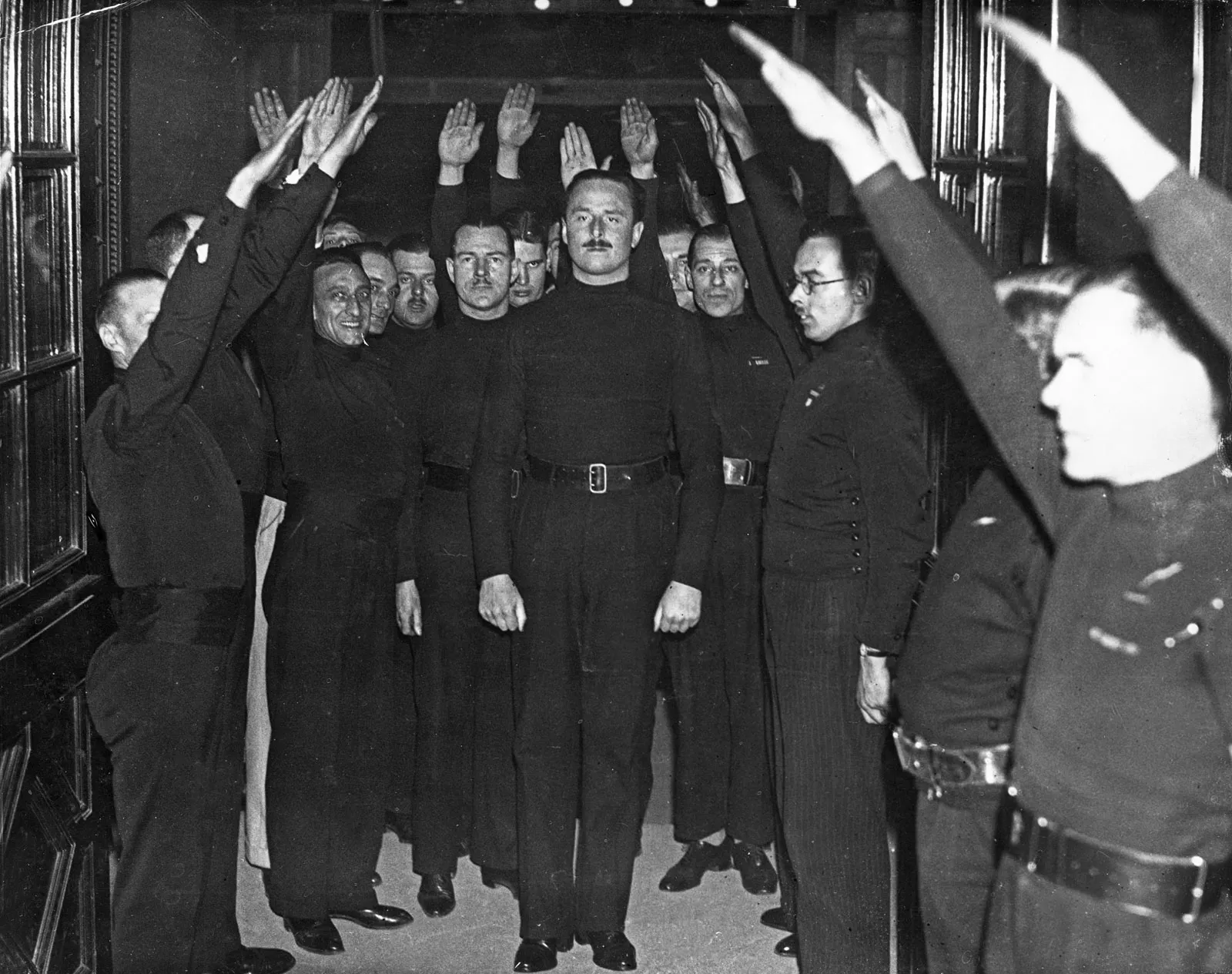
This article by Peter Kennedy is reprinted from Comrade, the newsletter of the Mosley veterans organisation Friends of O.M., and was first published in November 1996 in honour of Sir Oswald Mosley’s centenary. The webmaster of this blog, Peter Rushton, attended the Mosley centenary dinner that month at the Royal Scot Hotel, London.
[Este artículo ahora también está disponible en traducción al español.]
“I could not ask to live at any other moment of history than this, because never before has mankind been confronted with such choices of disaster or greater heights: to live in that sense that you are Englishmen, are Europeans, that you come from people who faced tremendous odds again and again. Much is against you but you have within you that Will, that Spirit, above all that Faith and Belief which will lead the generations to come to look back at you in the pages of history with the proud words: To England, To Britain, To Europe – They were true.”
Sir Oswald Mosley, 1963
A century on from his birth, Oswald Mosley and the movement he led defy the categorisation of political phenomena in a moment of time. Through the backdrop of their great crusades, the men and the movement reach out with a timeless call, and never more urgent than in this new dark age.
Mosley and those who took up his cause are the inspiring example of what might be achieved when large numbers of our fellow countrymen and women say “Enough”, and go into the streets and lanes of Britain to proclaim a message of national recovery and renaissance.

Sixteen years after his death, the Great Englishman and European remains an outstanding figure of creative imagination, courage and inspiration, the role model of the union of the intellect and will which he saw as the highest instrument of political action.
I have lost count of those who have said to me, “If Mosley were alive today, he’d sweep the country!” Who among us would dissent from that?! Even those who baulk at the prospect would have to agree that the interaction of the most gifted politician in British history, with the forces of decline and sleaze in this age of national ignominy would be stimulating indeed!
Two years ago the Establishment was caught in a spin when a Daily Express opinion poll showed that a third of the British people would vote for a Le Pen were such a leader and party available in this country. With all respect to M. Le Pen, I would back a British thoroughbred to do even better!
Older readers of Comrade are likely to have personal recollection of Mosley’s remarkable personality and qualities; a creative, analytical intellect allied to great charisma, energy, courage unequalled in British politics, and legendary gift of speech that spoke to reason and to the heart.
To be loved is not a condition to which even the most admirable politician can usually aspire, but Mosley was genuinely loved by his followers. He had that rare gift for inspiring devotion and fidelity. When his biographer Robert Skidelsky said that Mosley developed a personal relationship with the people of East London unique in British politics, this was also the exuberant representation of the wider bond between the man and the movement.
“If only Mosley….!” Awesome indeed were the gifts that Mosley took into his life’s battle, but – and here surely is where the “if” is located – they were unconsummated by fate’s most critical and elusive gift: timing.

British Union was launched when the slump had peaked. Even so it grew over a seven year period during which the jobless trend dipped and the “international situation” got worse. Scarcely conducive factors for a revolutionary patriotic movement urging: “Mind Britain’s Business”.
Yet despite this, the movement entered the life of the nation as no other young political force has ever done. It set about destroying the class-based political culture of Britain, confronting the patriotism versus progress orthodoxy by uniting each in a dynamic new creed.
In doing so of course it inevitably attracted (to a degree unparalleled in British history) the hatred of the forces of class war, liberalism and reaction – its membership peaking on the eve of the war that was to silence British Union as a prelude to putting an end to Great Britain.
As Mosley said, for the Movement this war (an event that saw the paradoxical coalition of British class warriors and reactionaries) was a disaster of limitless proportions.
When t was over, the potent and enduring legacy of the Establishment’s anti-Mosley propaganda, combined with the tranquillity and prosperity of the 1950s and ’60s to ensure that the new Union Movement fought along a very hard and inhospitable road. So for the second time in four decades, a ruinous Establishment and its placemen were fortunate in History’s caprice.
What might have been achieved had fate showered the gift of beneficent timing on a man of genius, rather than on the Macmillans, Wilsons and Majors? No war, no loss of Empire, no servility to foreign bankers and politicians, no ‘multicultural’ Britain.
Instead a peaceful, noble, dynamic, homogenous Britain – a nation wherein, to recall the Objects of British Union, “All shall work and thus enrich their country and themselves… Opportunity shall be open to all, but privilege to none… and the barriers of Class shall be destroyed and the energies of every citizen devoted to the service of the British Nation. ” Compare these words and vision with the conditions of Britain today.

But if Oswald Mosley is the Lost Leader, what residual strength and encouragement can we draw sixteen [now forty-five!] years after his death? Surely this; that Mosley’s life and record, and that of his Movement, are an inextinguishable beacon in a very long night in the life of our country and continent.
We are no longer a homogenous, racially coherent nation. Even to speak of “Britishness” is to court the surveillance executives of the race thought police. To this extent alone, the challenge before us is greater than at any time in our history.
Our politicians are muddling us into crisis with the rest of Europe, while courting the disaster of global free trade and the low wages, sweated conditions and all that comes with it. And linked with the unrestricted global market is another 21st century nightmare; the threat of massive illegal immigration from the Third World to Britain and other European nations.
Meanwhile our young people stare into a future emptied of worthwhile work, homes, and a sense of fulfilment, but spewing out a sense of hopelessness and decay, crime, pornography and degradation. Older generations look on, wondering or fearing what has happened to this country of theirs.
This much is certain. The political-social-cultural system that is responsible, cannot reform itself. It must be swept away and replaced. Capitalism has sacrificed the happiness of the many, in the pursuit of profit. It has forgotten that an economy exists to serve the people, and not the other way round. It rejects the notions of community and nation, with mutual obligations and transcendent loyalties, and instead regards these as no more than marketing areas made up of individual competing producers and consumers.

And worse could follow. The Daily Telegraph has cited a survey of 300 Conservative graduates, showing that the “New Right radicals” are indifferent to sexual ethics, oppose religion, and favour the decriminalisation if drugs. “They are individualist and very internationalist [while hostile to British membership of the EU). They marvel at the globalisation of capital. They are not as rooted in the culture of the nation state as senior Conservatives might be.” Their heroes are John Redwood, Arnold Schwarzenegger, and Victor Kiam. [A generation later, the author would have to replace Redwood with Nigel Farage!]
If the Right have injected new life into the cliché about knowing the price of everything and the value of nothing, Socialism – now in eclipse – has also suppressed the human spirit, this time for the sake of standardised equality.
It opposes the dynamic, has a love affair with mediocrity, and despises cultural loyalty, At root – and seen in contemporary form as ‘political correctness’ [later as ‘woke’] – British socialism in particular reveals a bias towards the perversion of human nature. Each of these creeds, socialist and capitalist, is entirely material in its orientation, yet capable of leaving millions in destitution.
Mosley shows there is an alternative, and Comrade has performed an invaluable service in giving the historical record of what Mosley stood for, what his Movement achieved, the kind of men and women who supported him, and the ideals and policies that inspired them. Against the decades of lies, vilification, fabrications and misrepresentations – a deep-dyed pattern which shows no sign of fading – the truth is being told.

What would Mosley say to us in 1996?
Here we can only speculate, but a combination of distinctive principles, noble vision, and an ever-adapting response to changing circumstances are surely the basic factors.
Mosley’s thinking was always ahead of events. He spared little thought for the past: living in the present and viewing the future. Mosley’s proposals for 1948 had moved on from those of 1938, because the world situation had changed. By 1962 and again in 1972 they had adapted yet again. The approach of a new century would find his response ranging once more, realigning his core thinking to new conditions. We must follow that example.
The quest for community, a desire to rediscover national identity, and the belief that a new socioeconomic order is required, are the three principal convictions cited by the historian Roger Eatwell as post-Fascism’s challenge to socialism, capitalism, and liberalism, now “re-emerging on the European mental landscape”.
It is a landscape which must be reshaped by the life’s work of Oswald Mosley and the Movement he led. The Spirit – and the Example – Lives: the Rest will Follow.

