
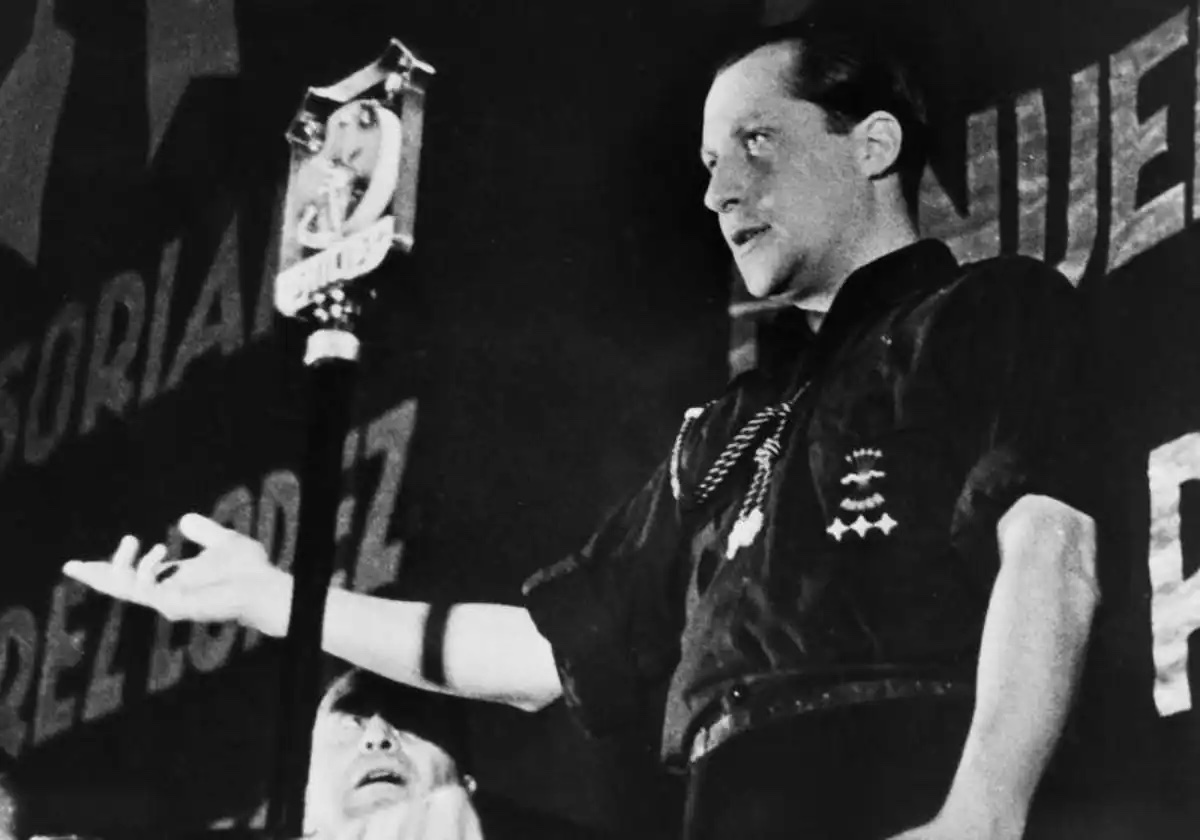
On 29th October 1933 at the Comedia Theatre, Madrid, José Antonio Primo de Rivera addressed his followers at the launch of a new patriotic movement that redefined Spanish nationalism.
This translation of his words was made by the English fascist Angus MacNab, a veteran follower of Sir Oswald Mosley and friend of William Joyce. For many years after the war, Angus MacNab lived in Spain where in the 1960s he became a friend of one of H&D’s British academic comrades.
*******

No whole paragraph of gratitude: simply, “Thank you”, as befits our terse, military style.
When in March 1762 a man of ill omen called Jean Jacques Rousseau published The Social Contract, political truth ceased to be a permanent entity. In earlier, less shallow ages, States had historic missions to perform, and justice and truth were written upon their brows, and even upon the stars. Jean Jacques Rousseau came to inform us that justice and truth were not permanent categories of thought at all, but decisions of the will at any given moment.
Jean Jacques Rousseau supposed that each people as a whole possessed a soul of its own, higher in rank than each of our individual souls, and that this higher ego was endowed with an infallible will, capable at any given moment of defining justice and injustice, good and evil. This collective sovereign will was expressible only by suffrage – in which the majority conjecture prevailed over the minority one in guessing what the higher will might be. It follows that voting – the game of dropping little slips of paper into a ballot-box – had the power to tell us at any given moment whether there was a God or not, whether truth was true or false, and whether our country ought to go on existing or would be better advised to commit suicide.
As the liberal State followed this teaching faithfully, it ceased to be the resolute executor of the country’s destinies and turned into a mere spectator of electoral struggles. The only thing that mattered to the liberal State was that a certain number of gentlemen should be seated at the voting tables, that the ballot should begin at eight and end at four, and that the ballot-boxes should not be broken – whereas to be broken is the noblest fate that can befall a ballot-box. Thereafter, the liberal State must serenely abide by whatever emerged from the ballot, as if it had no interest in the matter at all. In other words, the liberal rulers did not even believe in their own mission. They did not believe they were there for the performance of an honourable task, but that anyone who thought the reverse and intended to assail the State, by fair means or foul, has just as good a right to say so and to do so as the guardians of the State itself had to defend it.

Hence arose the democratic system, which is, first of all, the most ruinous possible system for the squandering of energy. A man endowed with gifts for the high function of governing, which is perhaps the noblest of all human functions, was obliged to devote 80%, 90% or 95% of his energies to answering routine opposition criticism, to making election propaganda, to drowsing for hours on parliamentary benches, to flattering electors and enduring their impertinences – because it was from them that he was going to get power – to putting up with humiliation and indignities from those who, by very reason of the quasi-divine function of governing, were required to obey him; and then after all this, if he had an hour or two left after midnight or a few moments stolen from an uneasy repose, it was in that tiny period of spare time that the man endowed with gifts for governing was able to give serious thought to the basic functions of Government.
Later came the loss of the spiritual unity of peoples, for as the system worked by the achievement of majorities, anyone who set out to master the system had to obtain a majority of the votes. He had to obtain it, if necessary, by stealing votes from the other parties; and hence he must have no hesitation in calumniating them, in heaping the vilest obloquies upon them, in deliberately falsifying the truth, in not letting slip a single means of lying and vilification. Thus, although Fraternity was one of the postulates displayed on the title-page of the liberal State, there has never been a mode of collective life in which wronged men, in mutual enmity, have felt less fraternal than in the turbulent, unpleasant life of the liberal State.
Finally, the liberal State brought economic slavery, for the workmen were told, with tragic sarcasm: “you are free to work as you choose: no-one can force you to accept these conditions or those. However, as we are the rich, we offer you such conditions as we think fit. As free citizens, you are not obliged to accept them if you do not want to; but as poor citizens, if you do not accept the conditions we impose, you will die of starvation surrounded by the highest degree of liberal dignity.” And so it came about that in the countries possessing the most superb parliaments and the finest democratic institutions, you had only to go a few hundred yards outside the luxury quarters of big cities in order to find yourself amid noisome slums, where workmen and their families lived huddled together in well-nigh subhuman conditions. In the country, a farm labourer’s hours were sunrise to sunset in the broiling heat, but owing to the free play of liberal economics he was lucky if in the course of a year he got eighty days’ employment at three pesetas a day.
That is why socialism was born, and its birth was justified. We are not going to baulk at any truth: the workmen were bound to defend themselves against that system, which gave them merely promises of rights, and took no pains to provide them with a fair living wage. Yet socialism, which was a legitimate reaction against that liberal enslavement, went astray in three ways: first, it accepted the materialist interpretation of life; secondly, it adopted an attitude of revenge; and thirdly, it proclaimed the dogma of the class war.

Socialism – above all the socialism constructed in the passionless frigidity of the study by the socialist apostles in whom the poor working men believed, and who have been shown up for what they really were by Alfonso García Valdecasas – socialism, thus understood, sees nothing in history but the play of economic forces; everything spiritual is suppressed, religion is the opium of the people, patriotism is a myth for the exploitation of the underdog. Socialism says all this. Nothing exists but production and economic organisation. Workmen, therefore, must wring their souls well out, lest the least drop of spirituality should remain within them.
Socialism does not aspire to reestablish a social justice that has broken down through the faulty working of the liberal State; rather, it aims at reprisal. The further the injustice of the liberal system has gone in one direction, the further socialism seeks to carry its own injustice in the other.
Finally, socialism proclaims the monstrous dogma of class warfare. It proclaims the dogma that warfare between the classes is indispensable and occurs naturally in life, because there can never be any appeasing agent. Thus socialism, which started out as a just critique of economic liberalism, has brought us by a different route to the same pass as economic liberalism: disunity, hatred, separation, forgetfulness of every bond of brotherhood and solidarity between men.
Accordingly, when we, the men of our generation, look around us, we find a world in moral ruin, a world rent asunder by every kind of differences; and as regards what touches us most closely, we find a Spain in moral ruin, a Spain rent by every kind of hatred and conflict. We have had to shed tears in the depth of our hearts when we have travelled through the villages of this wonderful country of Spain, those villages where you can still find people, beneath the humblest exterior, possessing a rustic gentility which never makes an extravagant gesture or uses a superfluous word; people who live in an outwardly dry way, on an apparently arid soil but one that astounds us by the fruitfulness that bursts forth triumphant in corn and vine. When we have been through those lands and seen those people, and known what sufferings they endure at the hands of petty local overlords, and how they are forgotten by every party group, divided, poisoned by underhand propaganda, we could not but apply to all those folk the words that the folk itself sang of the Cid, to see him roaming through the land of Castile in his banishment from Burgos:
“Ah God, what a good vassal, had he but a good lord!”
That is what we ourselves have found in this movement which starts today: the legitimate lord of Spain, but one like Saint Francis Borgia, a lord whom death cannot take from us. And for that, it must be a lord who is not at the same time a slave to an interest of group or class.

The movement of today – which is a movement and not a party, indeed you could almost call it an anti-party – let all know from the outset that it is neither of the Right nor of the Left. For at bottom, Right means the aim of maintaining an economic organisation even if it is unjust; and at bottom, Left means the desire to overthrow an economic organisation, even if many good things should go by the board at the same time. Afterwards, these ideas are both decked out with a number of spiritual considerations. I declare to all who listen to us in good faith: all those spiritual considerations can find their place in our movement, but our movement will on no account bind its destiny to the group or class interest that lurks beneath the superficial distinction of Right and Left.
The Patria is a complete unity, wherein all individuals and all classes are integrated; the Patria cannot be in the hands of the strongest class or the best-organised party. The Patria is a transcendent synthesis, an individual synthesis, with ends of its own to achieve; and what we seek is that this movement of today, and the State which it brings forth, shall be the efficient, authoritarian instrument which serves that unchallengeable, permanent, irrevocable unity which is called the Patria.
And with that we already have the whole mainspring of our future actions and our present conduct, for we ourselves should be but one party the more, if we merely appeared in order to put forward a programme of concrete solutions. Such programmes have the advantage of never getting carried out. On the other hand, when you have a fixed attitude towards history and towards life, that attitude itself will provide the solution in any particular case, just as love tells us when we should quarrel and when we should embrace, though a genuine love has not the slightest “programme” of either quarrels or embraces.
These are the things that are demanded by our complete sense of the Patria and of the State which is to serve the Patria:
That all the peoples of Spain, diverse as they are, shall feel themselves brought into harmony in one irrevocable unity of destiny.
That political parties shall disappear. Nobody was ever born a member of a political party; on the contrary, we are all bom members of a family: we are all citizens of a Municipality: we all work at a job. These are our natural units: the family, the municipality and the profession; and if these are the realities of our lives, what need have we for the intermediate, pernicious instrument of political parties, which, in order to unite us in artificial groups, start by disuniting us in our genuine realities?

We want less liberal verbiage and more respect for the deep liberty of man. Man’s liberty is respected only when he is regarded as the corporeal envelope of a soul capable of damnation or of salvation. Only when he is thus regarded can his liberty be said to be truly respected, and still more so if that liberty is combined, as we demand, in a system of authority, hierarchy and order.
We want all to feel they are members of a serious, complete community. In other words, there are clearly many kinds of tasks to be performed; some manual, some mental, others in the educational or social or cultural fields; but in a community such as we seek, let it be stated from the outset, there must be no passengers and no drones.
We want no song about individual rights of the kind that can never be enforced in the homes of the hungry. Instead, let every man, every member of the political community, simply by being a member of it, be given the means of earning a just and decent human livelihood by his work.
We want the religious spirit, which is the keystone in the finest arches of our history, to be respected and supported as it deserves; but that does not mean that the State should either interfere in functions which do not belong to it, or – as it used to do, possibly from motives other than those of authentic Religion – should share out functions which it is the State’s job to perform for itself.
We want Spain resolutely to recover the universal sense of her own culture and history.
And we want one last thing. If in some cases this can only be achieved by violence, let us not baulk at violence. Who has said – in speaking of “anything but violence” – that the supreme degree of the moral values consists in amiability? Who has said that when our feelings as human beings are outraged, it is our duty to be amiable? Dialectic, yes, as the first instrument of communication. But there is no dialectic admissible but that of the fist and the gun when the outrage is against justice or our native land.
These are the things we think about the future State which it is our job to build.
But our movement would not be fully understood if people believed that it was merely a mode of thinking; it is not a mode of thinking, it is a mode of being. We must not set before us political construction and architecture alone. We have to adopt, towards life as a whole and in each of our actions, an attitude that is human, profound and entire. That attitude is the spirit of service and sacrifice, the ascetic and military view of life. So let no-one imagine that this is a recruiting-station for the provision of benefices; let no-one imagine that we are assembled here to defend privileges. I only wish that this microphone could carry my voice into every working man’s home, to tell them this: Yes, we do wear collars and ties. Yes, it would be possible for you to call us “señoritos“. But we bring with us the will to fight for things which are of no interest to “señoritos” at all: we are here to fight, to get heavy but just sacrifices imposed on many people of our own classes, we are here to fight for a totalitarian State whose wealth shall reach the humble as well as the powerful. That is what we are like, because that is what the señoritos, the young gentlemen of Spain, always were like in history. That is how they achieved the real rank of señores, of gentlemen, because in distant lands, and in our own country too, they were able to face death and shoulder the harshest duties, for causes in which, as mere señoritos, they would have taken no interest at all.

I think the flag is hoisted. Now let us defend it cheerfully, poetically. In face of the advance of revolution, some people think that in order to unite everyone’s wills the most watery solutions should be proposed, and that in their propaganda they ought to conceal everything that might arouse emotion or betray a thoroughgoing, energetic attitude. How wrong they are! Peoples have never been stirred by any but poets, and alas for him who, when faced with the poetry of destruction, cannot uplift the poetry of promise!
In a poetical movement, we will uplift this fervent yearning of Spain. Ours shall be the sacrifice, ours the renunciation, and ours will be the victory, a victory which – need I say it to you? – we are not going to win at the forthcoming election. At that election, vote whichever way you think least bad. But that is not where our Spain will come from, that is not our setting, that turbid, exhausted atmosphere, like a tavern at the end of a crapulous night. That is not where we belong. Yes, I believe I am to stand as a candidate; but I do so without faith and without respect, and I say that now, though it may lose me all my votes. I care nothing for that. We are not going to that place to squabble with the habitués over the insipid scraps of an unclean feast. Our place is outside, even if we may pass through the other on the way. Our place is in the open air, under the clear night sky, sword in hand and the stars above. Let the others go on with their revelries. We outside, in vigilance tense, fervent and secure, can already feel, in the glad quickening of our inward parts, the brightness of the dawn.

