
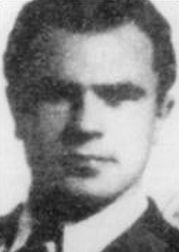
Anatoliy Golitsyn was arguably the most important and certainly the most controversial of several Soviet intelligence officers who defected to the West during the Cold War. He was born on 25th August 1926 and in 1944 as a young conscript was transferred to a counterintelligence school. After a year’s training he began his career in what was then called the NKVD (and from 1946-54 the MGB) but which most readers will know as the KGB (its formal title from 1954-91). For simplicity I usually refer to this service as the KGB throughout these blog articles.
Este artículo también está disponible en traducción al español.
As early as 1948 the young Golitsyn was identified as a highflying recruit and marked for rapid promotion. He took a two-year advanced course in counterintelligence, then from 1951-53 became a case officer in the Anglo-American Department at KGB headquarters in Moscow. In other words he was already well placed to pick up high-level gossip as well as detailed intelligence following the sensational escape of the KGB’s star British recruits Guy Burgess and Donald Maclean in May 1951, though he was only 24 years old when this took place. This accounts for the frustrating nature of Golitsyn’s intelligence when he eventually defected to the West: he hadn’t been sufficiently senior to know the full picture, but he was very well placed to know a great deal.
From 1953-55 Golitsyn was posted to Vienna, operating against British intelligence efforts in a city that was still under four-power occupation and which in some ways still resembled the Vienna depicted by Graham Green’s novella and Carol Reed’s film The Third Man. He then returned to Moscow for a four-year training course at the KGB’s Higher Intelligence School, spending part of 1959-60 back at headquarters in Moscow (again as a specialist in counterintelligence against NATO and the Americans).

In 1960 he received what was to be his final posting, as head of anti-NATO counterintelligence in Finland. As with many people of high ability, Golitsyn became frustrated by the pace of promotion and by sometimes having to defer to less able senior colleagues. Soon after arriving in Finland he got into a row with the rezident (i.e. the head of KGB operations in Finland) Col. Zhennikov. With remarkable confidence (or arrogance) Golitsyn went over his boss’s head and complained about him to Moscow Centre. The result was that Golitsyn quickly found himself marked as a troublemaker, and without any powerful patron to protect him. It was in this context that he began to look towards defection.
In December 1961 he turned up literally on the doorstep of the CIA station chief in Helsinki (Frank Friberg) and offered to defect. He was soon flown to the USA via Frankfurt, but his early months in Washington were frustrating, as his handlers in the CIA’s Soviet division came to see him as paranoid and unreliable.
However, the head of CIA counterintelligence James Angleton was very impressed by the quality of Golitsyn’s information. By the end of 1962 Angleton effectively rescued Golitsyn from being ignored by the CIA’s Soviet division, and during the first half of 1963 Angleton and his allies in the British security service MI5 began treating Golitsyn as their most important source in trying to track down Soviet penetration of the West.

A great deal has been written about subsquent disputes within American and British security and intelligence services over the so-called ‘molehunts’: but it’s only now with the present series of blog articles that Golitsyn’s vitally important earliest revelations – untainted by the inevitable massaging of facts to which all defectors eventually resort once they learn what their new audience wants to hear – can be examined.
In particular his very specific statement about the Cambridge spy ring having Jewish roots. To what extent is Golitsyn’s statement borne out by the facts: and why have these facts been disguised or distorted? This blog series will investigate.
Sources on Golitsyn:
In 1984 (more than twenty years after his defection) Golitsyn published his first book, New Lies for Old, which was an outspoken challenge to those in the West who were welcoming Gorbachev’s new glasnost and perestroika approach.
Golitsyn’s ideas were then picked up and promoted by a British anti-communist activist, Christopher Story, who published the newsletter Soviet Analyst and owned a London publishing company, Edward Harle Limited.
In 1995 Story published Golitsyn’s second book, The Perestroika Deception. This was ghostwritten by the veteran MI6 officer Stephen de Mowbray, who had also assisted Golitsyn with New Lies for Old.

Golitsyn died aged 82 on 29th December 2008, and de Mowbray died aged 91 on 4th October 2016. Two women who were closely involved in the Golitsyn case as senior MI5 officers died more recently, in effect closing a chapter of intelligence history: Stella Rimington died aged 90 on 3rd August 2025, and Ann Orr-Ewing aged 92 on 30th March 2024.
During the 2000s, Golitsyn’s publisher Christopher Story seems to have become increasingly unhinged, promoting anti-EU conspiracy theories including the allegation that European federalism was a long-term “nazi” plot and that Edward Heath had been “recruited by the Germans before the war.” He alleged that large sums of money were paid from “slush funds” to those who promoted the Lisbon Treaty and other EU schemes.
After Story’s death in 2010 his friend Greg Lance-Watkins (b 1946), educated at Clifton College and Sandhurst, continues to publish an archive of Story’s work online. Unfortunately, many online ‘right-wingers’ and conspiracy theorists now encounter Golitsyn through this eccentric lens highlighting his most obsessional later work, rather than studying his more valuable and accurate earlier statements which are only starting to become available and require detailed study of primary source material.

There is still no biography of Golitsyn – one of the most detailed accounts is a chapter devoted to him in Gordon Brook-Shepherd’s study of Soviet defectors, The Storm Birds (Weidenfeld & Nicolson, 1988). Other significant assessments appear in David Wise, Molehunt (Random House, 1992), and two biographies of Angleton: Tom Mangold, Cold Warrior (Simon & Schuster, 1991); and Jefferson Morley, The Ghost (St Martin’s Press, 2017). One of the leading pro-Angleton (and hence pro-Golitsyn) accounts is by CIA veteran Pete Bagley – Tennent H. Bagley, Spy Wars (Yale University Press, 2007) – in addition to a much earlier work by the pro-Angleton journalist Edward Jay Epstein, Deception: The Invisible War Between the KGB and the CIA (Simon & Schuster, 1989), whose opening chapters were later self-published by Epstein in 2013 as a much shorter paperback and ebook under the title James Jesus Angleton: Was He Right?
Nor do we have anything like a comprehensive assessment from British or American archives – the closest to that is a declassified CIA article about the long-running feud within the Agency between Golitsyn’s supporters and those who favoured the rival defector Nosenko. Hence an assessment of Golitsyn (and of the Jewish role in the Cambridge spy saga) depends on meticulous and painstaking study of a wide range of documents.

