

The Cold War’s most important defector believed there was “something Jewish” at the heart of the 20th century’s most infamous and highly placed network of communist subversion. Today the Real History blog begins a new series of articles examining this Jewish role in the Cambridge spy ring.
These articles will not be a rehash of ancient ‘conspiracy theory’. I shall be examining recently released documentary evidence from the most secret archives of the British security and intelligence services. Assumptions that underlie an entire genre of journalism and contemporary history will be re-examined and in some cases overturned.
In mid-December 1961 an unexpected Russian visitor arrived on the doorstep of the CIA’s station chief in Helsinki. Anatoliy Golitsyn was a 35-year-old Major in the KGB. He had joined the Soviet Union’s intelligence service in 1945 after a year’s training, and since 1960 was head of KGB counterintelligence work in Finland against NATO. For more than a decade he worked in a series of KGB posts in Moscow and Vienna specialising in analysis of their Western enemies, principally targeting the American CIA and FBI, and the British MI6 and MI5.
The Americans could scarcely believe their luck. Golitsyn was flown via Frankfurt to the USA, and after extensive debriefing he became the star protégé of CIA counterintelligence chief, James Angleton.

Several books have been written about ensuing controversies within the CIA, and Golitsyn has acquired a bad reputation among some journalists and contemporary historians. This article will not delve into those controversies, but I will claim that (even if some of his later published work was questionable) Golitsyn’s earliest revelations were of exceptionally high value.
In fact, I would argue that Golitsyn is the perfect example of a metaphor used by Sir Maurice Oldfield (head of MI6) who compared defectors to grapes in a vineyard. The “first pressings” of the grapes – i.e. the earliest revelations by a defector – were of the best quality; later information could often be of markedly inferior standard.
Among these “first pressings” from the KGB defector Golitsyn were devastating allegations about Soviet penetration of the British intelligence service. He had been a young but highflying officer when he became privy to some of these secrets. This meant that (frustratingly for his new friends in the West) he often knew fragments of important stories, but not the full picture. These fragments, however, were of vast importance and when put together with other intelligence, allowed analysts in Washington and London to make important breakthroughs.
Golitsyn provided the first lead that eventually exposed British Admiralty spy John Vassall, as well as a lead that helped expose longterm KGB undercover operative Konon Molody, alias Gordon Lonsdale. Yet another lead from Golitsyn triggered a reinvestigation of the former New Zealand diplomat turned academic Paddy Costello and his Jewish wife Bella. This produced important results that I briefly mentioned earlier this year and will be discussed further in a later article on this blog, though Paddy Costello’s sudden death in February 1964 (aged 52) prevented his interrogation.

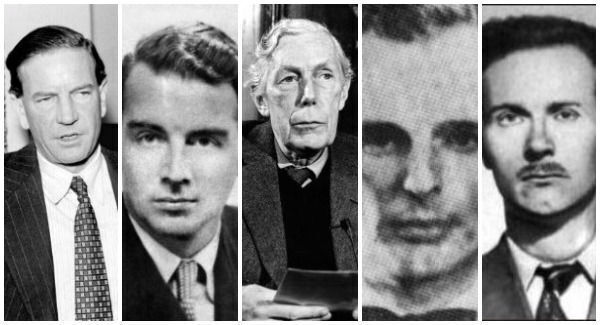
However, this introductory article will focus on the early information from Golitsyn that added important details to the story of the Cambridge spy ring. This is probably the best known spy saga in history. While there is still controversy about some names – and even about the extent to which one should refer to it as a ‘ring’ of spies working in close collaboration – five names are now accepted as having been involved, reflecting the key revelation first made by Golitsyn. Each of them had worked in some capacity as British diplomats and/or in the security or intelligence services, having been recruited while at Cambridge during the 1930s – Guy Burgess, Donald Maclean, Kim Philby, Anthony Blunt, and John Cairncross.
- Burgess and Maclean famously fled from the UK in May 1951, catching a cross-Channel ferry before making their way across Europe to the USSR.
- Kim Philby left MI6 under a cloud of suspicion later that year, but the case against him was never resolved and he retained the support of numerous MI6 colleagues until his eventual confession in January 1963, after which he fled from Beirut to the USSR.
- Anthony Blunt retired from MI5 soon after the Second World War but retained connections to his old service and was an honoured member of the British establishment, becoming a respected art historian and holding senior positions at the Courts of King George VI and Queen Elizabeth II. Knighted in 1956, Sir Anthony Blunt came under renewed suspicion in 1963 and confessed to MI5 in April 1964, but he wasn’t publicly disgraced until 1979.
- John Cairncross continues to be the least well known of the ring and this blog is now revealing the full context of his treachery for the first time. He was forced to resign from the Civil Service in 1952 after coming under suspicion during the Burgess-Maclean investigations, but the extent of his espionage didn’t start to become clear until his confession in February 1964, and only started to become public knowledge after press interviews in late 1979.
One crucial observation has generally been overlooked: that there was some Jewish background to the Cambridge spy ring: which was one of Golitsyn’s most important early revelations during his first interrogations in 1962. Note that he wasn’t saying any of the ring were themselves Jews (racial or religious), but that there was something essentially Jewish about the ring in general.

It’s fairly obvious why this would have been highlighted within the KGB and stuck in Golitsyn’s mind. Despite the very extensive Jewish role in the KGB itself and its predecessors, there were several stages at which a Jewish identity or link might have been seen as tainting the Cambridge spies, or in some way making their product suspect in some Soviet eyes. All the more so if that Jewish background were connected in any way to Zionists – whether in a political sense, or more especially in relation to Zionist intelligence services and arms dealing networks.
The latter was indeed the case, as I shall explain. Moreover, this mention of a Jewish background wasn’t some minor footnote: it was one of the key aspects that Golitsyn mentioned very soon after his defection, and it was highlighted several times by British intelligence officers in charge of the Cambridge spy ring investigation and associated ‘molehunts’.
Everyone now knows about one of Golitsyn’s two key revelations – that there was a ring of five KGB spies at the heart of Britain’s security and intelligence establishment. In Putin’s Moscow, they are celebrated as “the Magnificent Five” with memorial plaques and postage stamps in their honour. Yet until today, no-one (Jew or Gentile) has published Golitsyn’s other revelation – that the ring of five was in some sense essentially Jewish.

Arthur Martin was head of the D1 section, leading MI5’s molehunting investigations ever since the fallout from the Burgess-Maclean affair in 1951, and he was by the early ’60s Angleton’s closest ally in London. On 23rd May 1962, after reviewing the CIA’s detailed account of Golitsyn’s first revelations, Martin wrote to his immediate boss Martin Furnival Jones, explaining that according to this high-level defector, Burgess and Maclean “were members of a ring of five spies” and that Golitsyn “thought there was some Jewish background to the ‘Ring’.”
Readers should pause here and reflect on just how vitally important these words are, even though the second half of the statement has been suppressed for more than sixty years.
This was the very beginning of the concept of this “Ring of Five” – which has since become the most notorious story in the entire history of espionage. And at the very same time (and from the same source) as their first discovery of this ring’s existence, MI5 and the CIA were told that “there was some Jewish background to the ‘Ring’.”
Arthur Martin’s report was a very brief summary and was designed mainly for MI5’s continuing investigation of Philby – the semi-disgraced former senior MI6 officer who was by this time working as a journalist in Beirut but was still in touch with some of his old friends in the intelligence world.
Martin did, however, highlight this Jewish aspect and drew his superiors’ attention to the fact that Philby’s first wife Litzi was a German Jewess, and that soon after leaving Cambridge (years before starting his career in British intelligence) Philby had formed a London news agency in partnership with Peter Smolka (alias Peter Smollett), one of Litzi’s Jewish friends. Golitsyn had now identified Smolka as a Soviet agent associated with the “ring of five” – though not himself one of the five.

A few days after receiving Martin’s report, Furnival Jones passed on this summary of Golitsyn’s intelligence to the head of MI5 and noted that Golitsyn “strengthens the case against Philby without establishing it beyond any shadow of doubt.”
As I shall explain during this series of articles, soon after Golitsyn’s defection Jewish/Zionist forces began a concerted effort to steer MI5’s investigation away from the “Jewish background” to Soviet subversion that Golitsyn had specifically highlighted. For example, perhaps innocently, one of Golitsyn’s closest British supporters in the intelligence world – MI6 officer Stephen de Mowbray – strongly resisted the idea prompted by Golitsyn that the wartime intelligence officer and highly influential Jewish academic Isaiah Berlin was in any way suspect.
Isaiah Berlin had been de Mowbray’s tutor at Oxford and was responsible for steering him towards a career in MI6. It’s not at all clear whether this contention was linked to Golitsyn’s earlier suggestion that there was something Jewish about the ‘ring of five’ in general. No one ever suggested that Berlin was one of the ring, but he did have close links to some of them, especially to Guy Burgess.

MI5 records in relation to another close Jewish associate of the ring, Victor Rothschild (Lord Rothschild), are somewhat contradictory. For whatever reason, Rothschild (who worked in several capacities for the security service during the Second World War) was to a very large extent trusted by MI5 despite his close ties to several members of the ring. One reason evidently was his role in persuading a prominent Russian-born Zionist Flora Solomon to provide evidence to MI5 during the summer of 1962 which served to confirm their suspicions about Philby.
I would argue that the timing of this Solomon-Rothschild initiative was highly significant. Golitsyn’s defection was mid-December 1961, and we now know that during the following months the KGB reacted with panic measures, and emergency orders to its senior officers worldwide. It was late May 1962 when the top level of MI5 learned that Golitsyn was alleging that there was a ring of five KGB spies inside British intelligence and that there was fundamentally “something Jewish” about this ring. Within weeks the retired MI5 officer Lord Rothschild (who in theory should have had no reason even to know about Golitsyn’s evidence at this early stage) was supposedly approached by Flora Solomon at a party in Israel with her information about Philby.
She had a detailed discussion with Rothschild in London about this on 19th July 1962, followed by an interview with MI5’s Arthur Martin on 1st August: I have read transcripts of recordings of both these discussions. In other words the same officer who had studied the Golitsyn file (and who drew MI5’s attention to the alleged “Jewish background” to a “ring of five” spies), was just ten weeks later interviewing a prominent Russian-British Jewess in the home of perhaps the most influential Jew in England, discussing the central figure in that spy ring!

Was this the Zionist establishment moving quickly to take control of the narrative before their interests could be threatened? If not, then it’s certainly a remarkable coincidence – and the case of Flora Solomon will be examined in more detail as part of this blog series.
As the molehunt continued during the mid-late 1960s, Rothschild and his wife Tess were frequently consulted by MI5’s team of investigators, especially by Peter Wright (who in the 1980s became world famous for his controversial book Spycatcher). On 21st February 1966 Wright and his assistant Evelyn McBarnet had dinner with the Rothschilds at their London home, 23 St James’s Place. Their discussion over dinner was later written up by McBarnet.
During this dinner with the Rothschilds, Peter Wright revealed that “Golitsyn had had an idea that there was some Jewish background to the members of the Ring of Five.” (The chief MI5 spycatcher evidently believed that the Rothschilds were hearing this for the first time.) Wright added that this was borne out in Philby’s case via his first wife, and also in the case of an openly communist Cambridge contemporary James Klugmann (who wasn’t part of the ring but was closely associated with them and was one of the few open Communist Party functionaries to have involved himself with secret work).
One of the most fascinating aspects of recently released MI5 documents is that they were so unwilling or unable by 1966 to confront Jewish subversion head on, that they were reduced to asking two leading British Jews for their help in cracking this aspect of the case!
Unsurprisingly, the latter were quick to point MI5 in the direction of someone who was safely dead. “Lady Rothschild immediately suggested Tomás Harris who was, she said, undoubtedly Jewish and a very close member of the Circle. We discussed the possibility and agreed that he could have been involved, although, because his background was totally different from the rest, it seemed unlikely that he was one of the original Five. The Rothschilds thought that Harris’s character had similarity with that of Philby, and they also appeared to think that his loyalties might be suspect.”

Tomás Harris was a half-Spanish, half-Jewish art dealer who was a close friend of several of the Cambridge spies and was an important wartime intelligence officer in his own right, though he didn’t study at Cambridge himself. I shall write extensively about Harris and his family in another article in this blog series. He was killed (aged 55) in what appeared to be a car accident in Majorca in January 1964, a few weeks before the confessions of two of his Cambridge spy friends, John Cairncross and Anthony Blunt.
During May-June 1969 there was a rare documented instance of MI5 officers casting suspicion on the Rothschilds. This was a discussion between two K branch officers, Jack Cradock and Bridget Palliser.
Cradock noted information from a source who remembered that six years earlier – in July 1963, soon after Philby’s defection – the former MI5 officer ‘Buster’ Milmo (who was later a judge, and grandfather of the Labour politician Chuka Umunna) had raised doubts about Rothschild, noting that he had been at Cambridge with Philby and had been particularly close to both Burgess and Blunt.
Milmo had said this seemed “a most undesirable circle”, and that while he had no evidence suggesting that Rothschild was a Russian spy he thought the mere fact of this pattern of close association with proven spies meant he should be viewed as a bad security risk. (Milmo understood that at this stage – summer 1963 – Rothschild still had access to defence secrets.)
The source who reported this to Cradock had said he didn’t think Milmo had access to any further information about Rothschild, beyond what was already known, and added that Milmo had of course been very strongly convinced from the start about Philby’s guilt. He also pointed out that Milmo was “a fervent Roman Catholic and that Rothschild is a Jew” – implying that simply because of his Catholicism, Milmo might have an anti-semitic bias against Rothschild.
Replying to Cradock on 11th June 1969, Bridget Palliser mentioned Golitsyn’s statement which she quoted as: “Evidently all this ring are of Jewish origin.” This is a much cruder statement than the paraphrase included in Arthur Martin’s May 1962 minute, and perhaps comes from a later interrogation, probably when MI5 spoke to Golitsyn directly in 1963, or in one of his later interviews when he had become more dogmatic. Until MI5 release their full Golitsyn file, we shan’t know for certain.
As Palliser pointed out, the statement was in a literal sense untrue, in that neither Burgess nor Maclean was Jewish, but she added: “Philby had a Jewish wife, and her initiating role was strong enough, perhaps, taken together with the participation of Smollett, Klugmann, etc., to account for Golitsyn’s idea that the ring was Jewish. Anyhow, he had that idea.”

Palliser added that more recent information included interviews with John Cairncross, in which he suggested that former diplomat Paddy Costello (again safely dead by this time) had been one of the ring of five. As Palliser noted, Costello’s wife was of Russian Jewish origin and was without doubt “herself a Russian intelligence service agent”.
In relation to Rothschild, Palliser (unusually) put on record that “certainly Rothschild seems to have kept odd company and to some extent to continue to do so. It also seems to have become almost a legend that he and Tess are above suspicion while others, with lesser ‘crimes of association’ are considered suspect. He has, of course, helped us considerably and was the intermediary through whom Flora Solomon told us about Philby.”
It was, she concluded, difficult to say what relevance Golitsyn’s idea of the Cambridge ring’s Jewishness had to Rothschild: “their being Jews could link them to the Ring of Five; on the other hand it could also explain very naturally their tendency when they were young in the 1930s to be left-wing and to mix both with left-wingers and with Jews.”

On 4th November 1971 the Jewish aspect of the Philby saga was examined again by Stella Rimington, who later became the first woman to take charge of MI5. In analysing Flora Solomon’s motives for belatedly informing on Philby, Rimington used language that would today be viewed as bordering on ‘anti-semitism’.
In Rimington’s view, Solomon (who by this time was aged 76) “is a figure of central importance in the story of the Ring of Five, and it is important that we should understand her. …National loyalties could have had little meaning for her, the daughter of a Russian Jew of possible Bolshevik sympathies, married at 21 to an English Jew and later the mistress of the exiled liberal leader Alexander Kerensky, at that time scheming the overthrow of the Bolsheviks in Paris. It would not be surprising if she hardly knew whose side she was on and took intrigue for granted. The only consistent element in her background was Jewry and later Zionism, itself a world of shifting frontiers which could lead one from one year to the next into different attitudes to the Great Powers, including Russia and England, or even to one’s friends.”
For whatever reason, Rimington doesn’t seem to have put Solomon’s approach to MI5 in the context of Golitsyn’s revelation about an essential Jewish background to the Cambridge ring in general.
I would argue that it’s almost certain that Flora Solomon’s decision to talk to MI5 (via Victor Rothschild) in the summer of 1962 was motivated by fear among a circle of influential and well-informed Jews (whether communist, ex-communist or Zionist) that Golitsyn would provide information spotlighting the strong pre-war Jewish connection to high-level Soviet subversion, notably with the ‘Ring of Five’. As I shall explain in later articles, MI5 came to suspect that some other notable confessions during 1962-64 were part of an attempt to obscure the spy ring’s true origins.
Kim Philby’s third wife Eleanor told MI5 after her husband’s disappearance that he had begun drinking especially heavily during summer 1962: as Christopher Andrew (author of MI5’s official history) rightly points out, this was probably because he feared being exposed by Golitsyn – though conspiracy theorists who wanted to believe in a high-level MI5 mole (perhaps as high as Director-General Sir Roger Hollis or Deputy Director-General Graham Mitchell) argued that it pointed to Philby having been warned that he was again under suspicion, following Solomon’s statement.
Many years later in Moscow, Philby admitted to the Soviet journalist and historian Genrikh Borovik that when confronted by his old MI6 friend Nicholas Elliott in Beirut in January 1963 he suspected that this was the consequence of revelations by Golitsyn a year earlier, though he didn’t know precisely how much Golitsyn had known about him, and the curious method that MI6 adopted – confronting him in Beirut rather than enticing him back to London – suggested that they were unsure about Golitsyn’s testimony or doubted its legal admissibility.

It’s now known that soon after Golitsyn’s defection, the KGB carried out a rigorous “damage assessment”: during January-February 1962 they sent out instructions to 54 rezidents around the world including temporary safety measures such as suspending all meetings with important agents, and restricting contact to safer methods such as dead letter-boxes. Plans for a possible assassination of Golitsyn included trying to take advantage of any arrangements he made to give public testimony before a Congressional committee.
Thanks to a later defector (Oleg Gordievsky) we also now know that soon after Golitsyn’s defection, Philby’s final KGB handler Yuri Modin visited Beirut to warn him not to return to Britain, and to make contingency plans to flee to the USSR.
In other words, although there have been systematic efforts to discredit Golitsyn, it’s clear that the KGB viewed his defection as a very serious threat to their operations worldwide. It wouldn’t be at all surprising if international Jewry reacted in a similar way – though they were in a position to operate via character assassination rather than literal assassination, as well as using diversionary strategies.
Attitudes to Jews on the political right in 2025 fall into two categories. The most numerous on today’s ‘right-wing’ are those who won’t hear a word said against Jews or Israel: Zionism is seen as the ally of White Europeans against a Muslim ‘threat’. Meanwhile a minority (though very active) faction draws on older European traditions and views Zionism (and sometimes Jews in general) as a subversive threat. Often, however, such critics draw on vague notions that can easily be dismissed as conspiracy theory, or base their critique on traditional religious tropes that can be shrugged off by the majority of White Europeans today who have abandoned formal religious dogmas.
Golitsyn’s revelation about Jewish subversion takes us to a different level, and should be used as a prism through which to re-examine several important aspects of the Cambridge spy ring (and hence broader aspects of the Cold War and today’s world).
A series of articles here at this blog will attempt to do exactly that. Starting with the least known member of the Cambridge ring – John Cairncross.
