
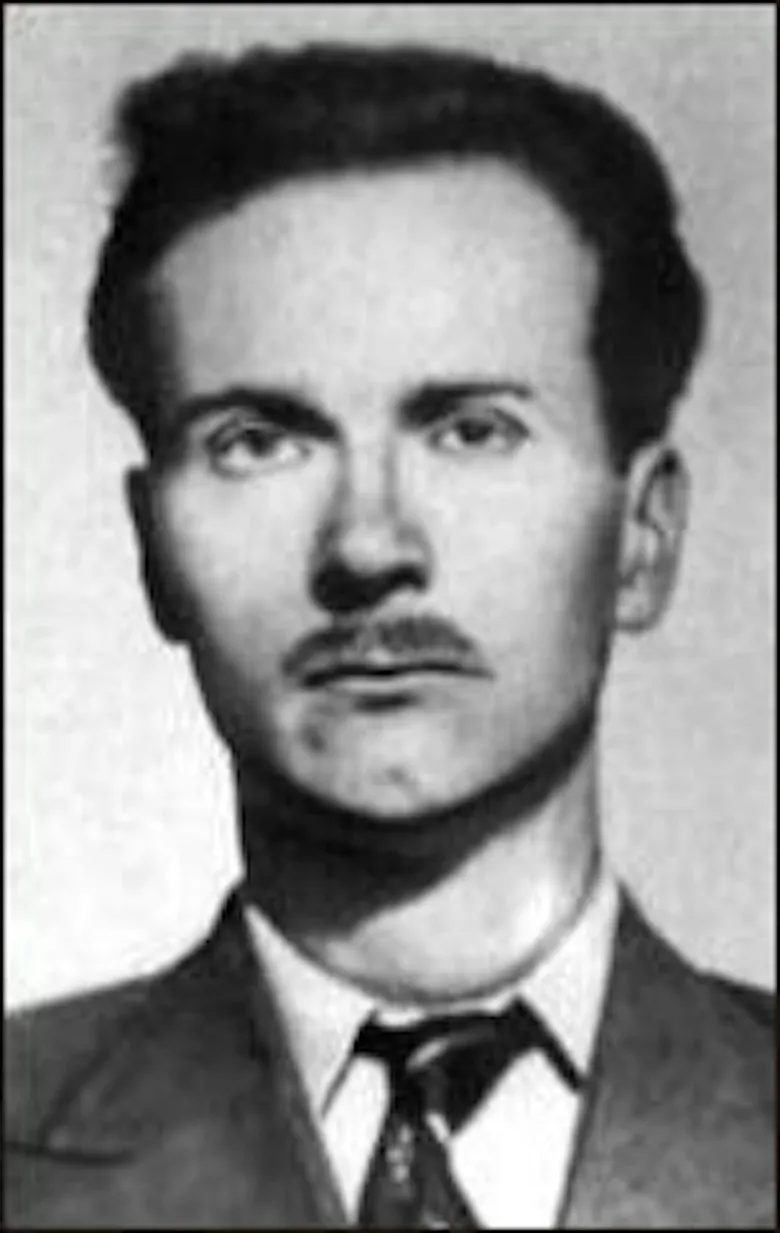
As I revealed earlier today, the KGB defector Anatoliy Golitsyn, who first warned about the existence of a ring of five Soviet spies in Britain – a ring eventually identified as the now notorious ‘Cambridge spies’ Burgess, Maclean, Philby, Blunt, and Cairncross – also warned that there was something essentially Jewish about this high-level Kremlin subversion of Britain.
What did Golitsyn mean by “something Jewish”?
As I shall explain in a series of blog articles, his allegation was fully justified, and this Jewish background to the Cambridge spy ring hasn’t (until now) been fully appreciated: most of the many authors who have written about this sensational story – the most remarkable espionage scandal in history – have either ignored or minimised the Jewish aspect.
I begin a new series of articles by examining John Cairncross, who is by far the least known member of the Cambridge spy ring. Cairncross’s posthumous memoir, The Enigma Spy, was published in 1997 and there have so far been two biographies – The Last Cambridge Spy (2019) by Chris Smith, and Agent Molière (2020) by Geoff Andrews.
Unlike any of those books, this blog article will analyse material from the latest UK archival releases on Cairncross – twenty-two volumes of MI5 files that were declassified earlier this year.
It turns out that while in some ways an atypical KGB recruit, John Cairncross was a very good example of the Jewish connection identified by defector Golitsyn as a key aspect of the Cambridge ring. As with his fellow-spy Kim Philby, Cairncross’s first wife was a Jewish immigrant, but the Jewish connection goes much further than that. Note that throughout this blog series I shall often, for the sake of simplicity, use the term KGB even though at the time of the Cambridge ring’s recruitment in the 1930s and during the peak of their espionage careers in the 1940s and early 1950s, this service was known first as the OGPU, then NKVD and later MGB, before the name KGB was adopted.
As is now recognised, the star recruits for Soviet intelligence in pre-war Cambridge came via the Comintern, a cosmopolitan network of well-educated and often Jewish Marxists who were able to operate on a higher level than the often clumsy Russian diplomats. For much of the 1930s (especially during the Spanish Civil War which gripped the imagination of many young Britons from 1936-39) the main appeal of the Comintern was not so much orthodox Marxism or domestic working-class politics as the glamorous international anti-fascist and anti-nazi struggle.

I can reveal for the first time that MI5 became convinced Cairncross’s espionage was connected to Jewish communist arms-dealing networks during the Spanish Civil War, and there are clear though incomplete hints in newly released documents that as late as the 1970s MI5 hoped to use Cairncross as part of a reinvestigation of two important undercover Jewish communists.
John Cairncross was the last of the ‘Cambridge five’ to be revealed publicly as a traitor, more than fifteen years after his partial confession to MI5 interrogators and more than twenty-eight years after he had first come under suspicion. Indeed he was the only one of the five who to a very large extent was still disguising or playing down his treachery by the time of his death.
When he died in 1995 aged 82, Cairncross was the last survivor of the ‘ring of five’. The main aspect that historians and journalists have highlighted is that he was from a different social background to the other four. He wasn’t exactly poor – his father was a fairly prosperous manager of an ironmongers shop and his mother was a schoolteacher, while his brother went on to be a senior economic adviser to several British governments – but his background was very different to the other Scottish member of the spy ring, Donald Maclean, who was the son of a Liberal MP and government minister.
Most writers on the Cambridge ring’s history (especially those with chips on their shoulder about not having attended Oxford or Cambridge) have been obsessed by a supposed ‘old boys’ network’ among the ‘upper classes’ that promoted or protected the ring’s members. In fact close examination suggests the opposite – the member of the ring who eventually had the most high-level family connections in Whitehall was Cairncross, who started out by far the lowest of the five on the social ladder! His brother Alec became one of the leading government economists under successive Tory and Labour governments in the 1960s, while his cousin Neil held a series of senior civil service posts including some with important intelligence responsibilities.
While all the other four members of the ring went straight from English public schools to Cambridge, Cairncross had already studied at two other universities (Glasgow and the Sorbonne) before arriving at Cambridge aged 21 in 1934. His biographer Geoff Andrews (using access to private papers) revealed in 2020 that contrary to previous authors’ assumptions, it wasn’t during his Cambridge years that Cairncross was converted to Marxism. In fact his ideological development began earlier, during 1932-34 while in Paris at the Sorbonne, where he met and was influenced by members of the leftwing Italian faction Giustizia e Libertà. (This revelation alone is worth the price of Geoff Andrews’ book, even though many of its other assumptions and conclusions now seem invalid.)

Several founders of this Giustizia e Libertà group were Jews, notably for example Carlo Rosselli (1899-1937), who led the first international group of leftists to reach Spain at the start of the Civil War in 1936, and was murdered in France in 1937 by French fascist cagoulards probably working for Mussolini’s secret service. For reasons that will become clear below, the fact that Cairncross was close to this group even before he reached Cambridge is highly significant and it’s unfortunate that MI5 never discovered it.
By all accounts, Cairncross was a man of very high intellectual ability. In 1936 he finished top of the Foreign Office entrance exam (one of the most elite tests anywhere in the world). His subsequent career was held back by what some authors regard as social snobbery, but which seems more likely to have been some form of what today would be called autism. Despite his evidently very high IQ, Cairncross often found it difficult to work effectively with others – and this was doubtless exacerbated by the stress of his double life, working in a series of sometimes secret government posts while simultaneously spying for Soviet intelligence.
Foreign Office personnel files show that Cairncross was soon deemed “unsuitable for representation”, i.e. he wasn’t suitable for any overseas posting as a British diplomat. The same files also state that “despite his academic record, he was unable to cope with the administrative work demanded of him.” He spent two years at the Foreign Office before transferring to the Treasury in 1938, although oddly this ‘unclubbable’ character obtained a sensitive post as private secretary to Lord Hankey in September 1940, then had two months in a similar role for Sir William Jowitt in March-May 1942.
The accepted version of his espionage career is that Cairncross was introduced by the prominent Cambridge communist James Klugmann to NKVD recruiter Arnold Deutsch. (Both Klugmann and Deutsch were Jews.) This recruitment was in 1936 or 1937. In his memoirs Cairncross dates it as May 1937 and pretends that he was tricked into the meeting with Deutsch: the entire autobiography is a strikingly dishonest attempt to trick posterity, as Cairncross had no way of knowing that top secret official documents on his case would eventually be released.
Numerous writers on espionage history have suggested that Cairncross didn’t become an especially active or valuable spy for the Russians until 1942 when he was posted to the then-secret but now-famous codebreaking centre, Bletchley Park.
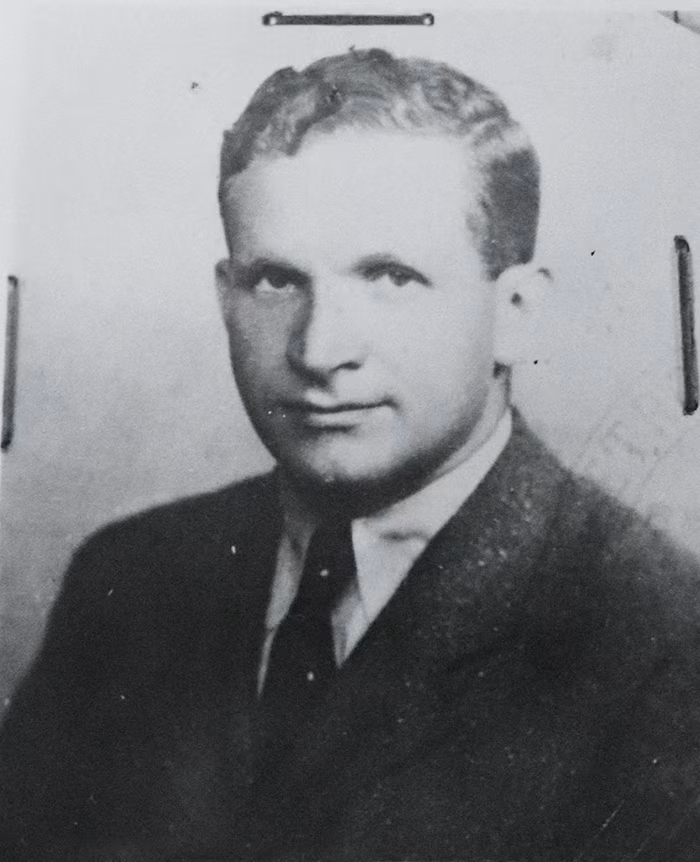
Close study of this year’s newly released documents reveals a very different story. Cairncross’s earliest connections to the Kremlin’s espionage networks involved Jewish Comintern operatives including arms dealers profiting from the Spanish Civil War. He lied repeatedly about the extent of these connections, and ten years after his supposed ‘confession’ MI5 concluded he had still not been honest with them.
The Cairncross case can now be seen as a missed opportunity for both MI5 and MI6 to try to understand the Comintern’s European networks that had been partly exposed by another defector, Jewish NKVD officer Walter Krivitsky, before his mysterious death in a Washington hotel room in February 1941.
There is some slight indication in the files that Cairncross was politically radical during his two years at Glasgow University, aged 17-19, but MI5 never seem to have developed detailed, reliable information about communism among Glasgow students in the early 1930s.
It seems most likely that Cairncross came to the attention of Jewish Comintern operatives during his two years at the Sorbonne (1932-34) but even during his later confessions he was keen to deflect MI5 interrogators’ attention from that period, claiming that he wasn’t especially political at that time. It’s now known this was untrue: his own private papers indicate that he was in touch with members of the influential anti-fascist group Giustizia e Libertà during this period in Paris.
What we now know for certain is that in addition to encountering well-known English communists such as Klugmann and John Cornford, Cairncross built further overseas Comintern connections during his second year at Cambridge via his friendship with Etienne Temboury, a postgraduate spending a year at Cambridge to improve his English before taking up a legal career in Paris.
He first met Temboury in late 1935, many months before the outbreak of the Spanish Civil War, but it was via this Frenchman that Cairncross was to build important contacts with Comintern operatives in Spain. This aspect of Cairncross’s story was later recognised by MI5 as vitally important, but no previous authors have discussed it.
Some of Temboury’s Comintern connections came via the Communist politician and lawyer André Berthon, for whom Temboury worked in Paris, but he also had high-level family connections of his own in Spain including relatives in Malaga who were part of that city’s business elite known as the “Alameda oligarchy”.
After just a few months in the American Department of the Foreign Office (and though he had been top of the 1936 entrance exam) Cairncross was transferred in February 1937 to Western Department, much of whose time was taken up with the Spanish Civil War. In theory this might have seemed a backward career move, but with hindsight it seems possible that fellow undercover communists arranged his transfer because it suited the KGB’s interests.
During most of 1937 and into the first weeks of 1938 Cairncross worked in the same room as Donald Maclean, a fellow member of what is now known as the “ring of five” Cambridge spies, though Cairncross always maintained that during this period he had no idea that Maclean was a fellow Soviet agent. He also claimed that he had no involvement at that time with Kim Philby, a third member of the ring, who in this period was based among Franco’s Nationalist forces in Spain as a Times correspondent but secretly working for Moscow. Indeed, Cairncross claimed that he wasn’t even conscious of Philby’s name until well into the Second World War when he joined Section V of MI6, where Philby was already a senior officer.

British government policy was to attempt to block arms purchases by Spain’s leftwing government who were trying to defeat a nationalist revolt (eventually led by General Francisco Franco). Theoretically this was an embargo on both sides in the civil war, but the nationalists were able to rely on supplies from Germany and Italy.
Consequently the Republican government became heavily dependent on Stalin’s Soviet Union and in practice on a network of often Jewish arms dealers operating clandestinely in defiance of the embargo. This network was run by Comintern recruits and longstanding agents of Moscow’s intelligence services.
At several stages the story of this arms dealing network is still murky and mysterious – partly because it involved the Soviet military intelligence service GRU as well as the NKVD/KGB, and also because of the shifting pattern of relationships between Stalin’s Kremlin and international Jewry. Most notoriously, about three-quarters of Spain’s gold reserves were transferred to Moscow on Stalin’s orders at the end of 1936.
The defection of several prominent Comintern figures (some of whom eventually formed an “anti-Stalinist left”) was part of this story – and as we shall see in later episodes of this blog series, the dispute between Stalin and “Old Bolshevik” Jews had implications for the Cambridge spy ring’s development.
We shouldn’t be surprised that just as (in line with Golitsyn’s later revelation) all five of the Cambridge spies had close connections to international Jewry (even though none of them were Jews), all five were in this vital period, very early in their espionage careers, closely involved with the Spanish Civil War.
I shall discuss the other four members of the ring in later articles. Philby and Burgess had supposedly shifted to the ‘right’, with Philby based among Franco’s nationalists at their Burgos headquarters and having acquired a pro-Franco mistress, while Burgess was working with right-wing British conservatives and nationalist supporters, some of whom were among his circle of fellow homosexuals. Maclean and Cairncross had supposedly become respectable diplomats, and during most of 1937 they each worked in the Foreign Office department most concerned with Spain. Meanwhile Blunt was still in Cambridge, teaching at Trinity College, and using his contacts in academic, political, and homosexual circles to spot potential further recruits for Soviet intelligence.
From numerous once secret documents, we can piece together how all this involved John Cairncross as early as 1937 – and we can see that his often-repeated tale about having been “tricked” into recruitment to the KGB was merely a fable intended to distract MI5’s investigators. We can also begin to trace how rather than being the least important and fifth member of the ring, Cairncross was chronologically perhaps its first member and had particular ties to Comintern arms dealers (including Jews) closely involved with the war in Spain.

Soon after his transfer to Western Department in early 1937, Cairncross was approached by his old friend Etienne Temboury while on a trip to Paris and introduced to Victor Haefner, an “anti-nazi” German émigré who was part of Jewish business networks. Haefner asked for Cairncross’s help in evading the embargos on arms sales to the Spanish Republic. He was to become a close associate of Cairncross for the next few years, and as late as 1945 was still trying to exploit contacts in London to infiltrate himself into the British military intelligence apparatus in occupied Germany.
Cairncross eventually admitted to MI5 (both in 1942 and then in more detail when questioned under pressure in April 1973) that during spring or summer of 1937 while working on Spanish matters at the Foreign Office he had received a letter from Haefner asking for help obtaining permits for export of arms to Spain. During this period Cairncross’s fellow Cambridge spy Donald Maclean was working in the same department (but Cairncross unconvincingly continued to claim that he was unaware of Maclean also being a Soviet spy!).
Victor Haefner was one of the earliest generation of aviators during the First World War, where he served in the Royal Bavarian Air Force (part of the nascent Luftwaffe) and fought against the British in Palestine (then controlled by Germany’s Ottoman Turkish allies). Unconfirmed rumours suggest that during that war he was friendly with Hermann Goering, but during the early 1920s he drifted into corrupt and treacherous circles involving international Jewry and several spy networks.
While working postwar as a civilian pilot for Lufthansa and related companies, Haefner was convicted several times by the courts of the Weimar Republic – i.e. he was known as a crook and a spy long before the Third Reich era. He served two years of a five year sentence for treason during the mid-1920s, and at the end of that decade was again jailed, this time for fraud. He was released from Spandau prison in 1930.
Soon after his release, Haefner joined an Italian anti-fascist scheme led by the Giustizia e Libertà activist Giovanni Bassanesi to fly over Milan and drop anti-fascist leaflets. Bassenesi was part of the Paris-based leftwing network led by the Jewish-Italian émigré Carlo Rosselli, which we now know was Cairncross’s first high-level contact with Europe’s undercover communist world, during his time at the Sorbonne in 1932-34. In other words the Haefner connection wasn’t a passing coincidence: it was a vital part of Cairncross’s early work for Soviet intelligence and points to his being a core member of what became the Cambridge spy ring.
In March 1933 Haefner was briefly interned by the new Third Reich authorities, but he is one of many examples where the Hitler regime was remarkably merciful towards some of its most dangerous opponents. He was soon released and went into exile (with his partner and future wife, opera singer Else Peppler), first in Switzerland, then in France.
One of his first political acts in exile was to write an ‘anti-nazi’ letter to the Vatican Secretary of State, Cardinal Pacelli (the future Pope Pius XII). This was an attempt to disrupt negotiations for a Concordat between the Catholic Church and the Third Reich which were then under way, involving Cardinal Pacelli and Hitler’s Vice-Chancellor Franz von Papen (a Catholic aristocrat).
Haefner’s letter was clearly part of a Comintern/Jewish propaganda campaign and it’s interesting as a precursor of later similar propaganda that generated what we now think of as the ‘Holocaust’ story. According to MI5 files, Haefner’s letter “went on to prophesy that the NSDAP would set out to exterminate first Jews and then Catholics if the system wasn’t stopped in time.”

From 1935 Haefner’s main work was as representative of the aviation and armaments firm AEKKEA, based in Piraeus, Greece, but run by a German Jewish émigré, Antonius Raab. Haefner and Raab had known each other as fellow pilots during the First World War, and by the 1930s were close colleagues in a shady world of international Jewish arms dealers closely connected to the Comintern and to the Soviet military intelligence service GRU.
Several weeks before the nationalist revolt against Spain’s far-left government, Haefner was issued with a Spanish passport in a false name (Juan Maria Bellver de la Bellacasa) and was appointed as an instructor to the Spanish Republican air force. This occurred within days of the liberal Spanish President Zamora being ousted in favour of a socialist with Comintern links, Popular Front leader Manuel Azaña.
Another important figure in the far left’s takeover of the Spanish air force was the recall from Washington of Gen. Franco’s brother Ramón Franco, who held opposite political views to the future caudillo. Ramón Franco was a freemason with leftist views: he was promoted to take command of the Republican airbase in Majorca.
Shortly before being put in touch with Cairncross, Haefner was appointed a member of the Republican arms purchasing commission in Paris, which was seeking various covert means to circumvent the arms embargo. Having learned of these illegal activities, the French authorities detained Haefner in September 1937 and he was released at New Year 1938, moving across the border into Holland where under his new Spanish identity he continued his arms purchasing activities, involving both Raab and another notorious Jewish arms dealer, the Dutch-based Daniel Wolf.
Early in 1939 Haefner again contacted Cairncross, this time seeking his help in making connections to scientists at the Admiralty and Air Ministry. Haefner claimed to have valuable information about a new invention that could advance the relatively new science of radiolocation.
MI5 were suspicious of him for several reasons, and soon after the outbreak of war, Haefner was interned as an enemy alien with suspect links to several foreign intelligence agencies. They noted that Haefner was “persona non grata in practically every European country owing to his alleged espionage activities”, and found a letter from Haefner to Raab, in which Haefner seemed to be referring to a Valencia bank account relating to arms deals and suggesting that some reward or commission would be paid to Cairncross for his secret help.
MI5 later came to suspect that highly placed Soviet agents had protected Cairncross by ensuring that the early investigations of his Comintern arms-dealing connections were dropped. A further problem was that by the time they came to re-examine this aspect of the case (in the early 1970s) their own archives on Haefner and others had been heavily ‘weeded’: i.e. historic information that was deemed no longer relevant had been destroyed. Belatedly they discovered via contacts in the West German security service BfV that Haefner had died on 5th September 1967, aged 71: his death was registered in Nuremberg but there was no information on when he had moved there or on his activities in the late 1950s and 1960s.
Long before anything was known about the Cambridge spy ring, Cairncross came under brief MI5 scrutiny due to his connections with Haefner, and also due to another very mysterious incident which in retrospect was seen as sinister. In August 1938 a letter was posted to Cairncross from Amsterdam: because of the different continental fashion of writing numbers, the letter was delivered to the wrong address. The householder opened it, and after seeing the suspicious contents handed it in to police at Scotland Yard.
The letter contained what seemed to be high-level political gossip about the mysterious death of one of Himmler’s staff officers (supposedly connected to a visiting Italian VIP) and though unsigned it ended with the word “Fraternally” – a term that in England would usually be associated with communists. There was a faint implication in the letter that the mysterious death might have involved a homosexual scandal inside the SS. If so, 1938 was exactly the time one might expect Comintern agents and Jewish propagandists to be trading in such gossip. In February 1938 Himmler and the SS had helped to destroy the career of the Wehrmacht’s commander-in-chief, Werner von Fritsch, over homosexual allegations, and perhaps in retaliation similar allegations had been made against a senior SS officer Curt Wittje. Himmler dismissed Wittje from the SS even though the allegations couldn’t be definitely proven, but helped him find another career elsewhere. Himmler took the view that he should err on the side of potential injustice “rather than allow the plague of homosexuality to enter the SS.”

Early in 1939 both the Comintern and international Jewry were concerned about the direction of British policy. The Romanian ambassador in London, Viorel Tilea, misled the British government about a non-existent German threat to Romania’s oil fields and this eventually had the effect of bouncing British Prime Minister Neville Chamberlain into issuing a British guarantee to Poland that she would be defended against any German invasion (though significantly not against a Soviet invasion!)
Stalin was naturally anxious to know what direction British policy was taking, and Cairncross met with a series of highly placed Whitehall officials to pick up political intelligence and gossip. He made notes on these conversations and handed them to his fellow Cambridge spy Guy Burgess. Due to internal chaos inside the Soviet intelligence machinery – including the purging of some of the Comintern Jews who had been instrumental in creating the Cambridge spy ring to begin with – Cairncross’s intelligence was temporarily being passed to the Russians via Burgess rather than via any London-based Soviet officer.
This situation was to have catastrophic consequences for Cairncross soon after Burgess and Maclean fled to Moscow twelve years later (see below).
His handwritten notes have now been published as part of Cairncross’s MI5 file. They show that he met with a range of junior but well-placed officials all about his own age, often private secretaries to important ministers who were able to reveal top-level government thinking. They included John Colville, then in the Foreign Office Eastern Department, best known to historians for his later role as Churchill’s private secretary; Frank Roberts, then in Central Department and later one of the most influential British diplomats of the 20th century; Richard Speaight, a Foreign Office expert on Poland; Roderick Barclay, of Southern Department; David Pitblado of the Dominions Office; Henry Hankey of Central Department, son of the senior civil servant Lord Hankey; Arthur Drew, a War Office civil servant who eventually became its last Permanent Secretary; and John Higham, assistant private secretary to the First Lord of the Admiralty.
This was a carefully selected range of well-placed civil servants and diplomats, none of them by this stage especially senior, but all ‘high flyers’ trusted by their senior colleagues and able to offer an informed perspective on the likely direction of Chamberlain’s foreign policies.
Cairncross’s file indicates several occasions when he was being vetted by MI5 but where for various reasons the suspicions attaching to him weren’t taken seriously. Sometimes this was due to pressure of work or incompetence, for example in July 1942 just before Cairncross obtained his most secret posting to Bletchley Park, an MI5 officer noted on his file: “we have to watch our step in this case, as Cairncross’s father is working in some capacity in the War Cabinet.”
Of course this was nonsense: Cairncross’s father ran an ironmongers’ shop in a small Scottish town! Evidently MI5 was confusing him with John Cairncross’s elder brother Alec Cairncross, the economist, who was by this time a 31-year-old civil servant. Many years later Sir Alec Cairncross did become influential in Whitehall, but there should have been no reason in 1942 for MI5 to be apprehensive about him pulling strings.
It’s far more likely that the various friends of the Comintern inside the civil service and even in MI5 were making sure that John Cairncross was protected. Unlike some of the other Cambridge spies he didn’t really have the sort of personal or family ties that might have helped him automatically.

During 1940-42 Cairncross worked as private secretary to Lord Hankey, with access to a range of government secrets including the earliest stages of research into the nuclear bomb project, codenamed Tube Alloys. He was able to supply the KGB with intelligence on the political and strategic aspects of potential nuclear weaponry, though (as is now well known) Stalin’s agents had access to the technical/scientific aspects of the project via other spies such as Klaus Fuchs.
At the start of the war Hankey had some influence over attempts to reorganise the intelligence services, but by late 1941 he was starting to be marginalised due to falling out with Churchill. For a few weeks in early 1942 Cairncross moved to a new job as private secretary to Sir William Jowitt, a barrister and Labour MP who was head of a committee working on long-term plans for postwar reconstruction.
In early 1942 there was a risk that Cairncross would be called up for military service, which would vastly reduce his usefulness to the Russians. Yet again he was able to pull strings, and in this case it was logical enough for someone of his ability and facility in modern languages to be sent to Bletchley Park rather than for regular military training. He officially joined the codebreaking service GC&CS on 1st September 1942 and remained there until the end of May 1943, exactly nine months.
Because Bletchley’s most famous work involved the Enigma code, Cairncross’s posthumous memoir was only semi-accurately (but with an eye to book sales) titled The Enigma Spy. He did supply his Soviet controllers with information about Enigma, as well as Luftwaffe codes, but his work in “Hut 3” at Bletchley wasn’t in cryptography itself, rather it was translating and analysing decrypted messages.
A mathematician such as the now legendary Alan Turing (or even in some cases a housewife with an aptitude for crossword puzzles) could work wonders breaking a code, but one then had to assess the meaning and significance of the decrypted message (and do so very quickly): this was a job not for mathematicians or early computer whizzkids, but for linguists, historians, and political scientists as well as military experts.
Probably Cairncross’s most important spying for the KGB at Bletchley involved a different cypher machine – not Enigma but the Lorenz machines used by the Wehrmacht. Bletchley’s breaking of these Army codes was codenamed ‘Tunny’, and it gave the Allies crucial strategic intelligence about German military secrets from 1942-45.
His memoirs would have been more accurately titled The Kursk Spy because during 1942 and 1943 Cairncross provided the Russians first with detailed information about the new German Tiger tanks, enabling Soviet designers to come up with more powerful shells to pierce the Tiger’s stronger armour; and then with complete versions of German intelligence about both the locations of Luftwaffe squadrons and the deployment of Soviet forces on the Kursk front.
Though the precise significance of Cairncross’s information is still disputed by military historians, he clearly played some part in assisting the Red Army’s victory at Kursk in July-August 1943, the largest tank battle in history – although by the time this battle took place Cairncross had officially transferred from Bletchley to MI6 on 14th June 1943 after taking a fortnight’s leave following his departure from GC&CS.

During his later interrogations by MI5, Cairncross laid great stress on the Bletchley period of his career but sometimes confused the issue by saying he had handed over a decoded “German plan for an attack on Kharkov.” One of several such confusions was in an interview with the senior spycatcher Peter Wright in Paris on 19th September 1967. Cairncross claimed that “his analysis had shown there would be a major German air attack on Kharkov just before the land attack. He had been able to give ‘Robert’ [his then Soviet controller] details of the distribution of the German planes, the airfields they would fly from, etc.. ‘Robert’ told him that as a result of his information they had been able to inflict defeat and that over 400 German planes had been destroyed. Cairncross emphasised that the information which he had related to air forces, not ground, except incidentally. He had the impression that the major part of GC&CS’s information relating to the Eastern front was Air Force.”
Other sources (including Cairncross’s biographers) concur, however, that this intelligence related not to Kharkov but to the German attack on the Kursk salient in July-August 1943. Based on his analysis of Luftwaffe signals, Cairncross gave the Russians accurate information about the precise location of German squadrons, allowing the Soviets to destroy hundreds of aircraft. Geoff Andrews puts the number at 500.
There was an operation against Kharkov (in effect the fourth battle of that name) in August 1943 just after the Battle of Kursk, it resulted in Soviet forces recapturing the city, but the circumstances don’t match Cairncross’s account which we can assume refers to Kursk. His repeated references to Kharkov might have been part of his scheme to make MI5 believe that he was hopelessly muddled about even the most important events of 20-25 years earlier, and hence excuse his other obfuscations.
It’s a curious but intriguing fact that among the Bletchley codebreakers working on Tunny was Peter Benenson, son of the leading Anglo-Zionist Flora Solomon who had a vital part in another aspect of the Cambridge spy saga (to be addressed here in a later blog article) but seems not to have known Cairncross.
Perhaps it’s fortunate that Bletchley’s codebreakers were highly compartmentalised, and it’s apparent that neither Cairncross nor Benenson was in a position to betray the fact that Jewish Agency codes were also being broken, as were those of Jewish paramilitary groups some of whom were in an uneasy alliance with the British while others were openly opposed, and who from 1945 to 1948 were to be in a bloody terrorist war against the British Empire.
Long after leaving Bletchley, Cairncross had lunch with a colleague called Henry Dryden who had remained with the postwar GCHQ doing similar work. This was in 1949 at the start of the Cold War, and Cairncross made tentative efforts to find out from Dryden whether there had been similar codebreaking success against the Soviets. Parts of this story (including Dryden’s name) are redacted from published versions of MI5’s Cairncross files.
An influential Jew who certainly did know Cairncross and was also close to other figures in the Cambridge spy ring was the Russian émigré and MI6 officer Alexander Halpern, whose significance will be discussed in a separate article in this series. One of the many deliberate confusions that Cairncross later introduced in his MI5 interrogations was pretending to dislike Halpern and implying that he was instead close to Halpern’s wife Salomea.
Via Halpern he built a close friendship and professional contact with the BBC radio producer Anna Kallin, a Russian Jewish émigré who provided Cairncross with translation work on many occasions after the war and gave him a further entré into London’s cultural elite. Kallin was born in Moscow in 1896 and during the early 1920s was the mistress of the artist Oskar Kokoschka. Like Guy Burgess, she was a longstanding friend of the Jewish philosopher and wartime intelligence officer Isaiah Berlin.
By the time the Battle of Kursk began, Cairncross had already left Bletchley Park on 31st May 1943 and joined MI6 a fortnight later. For a year he worked in Section V of MI6 (where Kim Philby held a more senior role). Cairncross dealt with analysing intelligence reports from Germany, before being transferred again in 1944 to work on political intelligence related to the Soviet Union. By that time he was working under an academic expert on Eastern Europe and the USSR, David Footman, who was himself later suspected of doubtful loyalties.

A handful of documents indicate that Cairncross had a very significant role at MI6, which has been downplayed in almost all previous accounts of his career. Correspondence between MI5 and MI6 during the summer of 1944 shows that as a Section V officer, Cairncross was entrusted with highly secret British analysis of changes within the German intelligence structure, especially as regards Himmler’s success in winning his struggle with the Abwehr to establish the pre-eminence of the SS intelligence arm (usually known as the SD).
Cairncross was an MI6 specialist on Germany throughout the crucial months leading up to the attempted assassination of Hitler in July 1944, including the controversial defection to the British in early 1944 of a senior Abwehr officer in Istanbul, Erich Vermehren.
MI6 reports during the first half of 1944 warned that Himmler and the SS/SD would demonstrate “superior effectiveness” in intelligence matters compared to the often corrupt and lazy Abwehr. Himmler’s elite force included “intelligent men who are not Party hacks” and was “the most advanced example yet produced of a fusion between party and state organisations, which has been Hitler’s aim since his rise to power, … a well organised and experienced security and espionage service, bound by faith and works to the Nazi scheme of things.”
MI5 concurred that the SD would “probably be more formidable that the Abwehr.”
In this context it’s absolutely crucial that Cairncross was the MI6 Section V specialist on the SD and its growing power: he would undoubtedly have reported on these matters to his Soviet masters, and there are of course very special reasons why in this context we should take note of Golitsyn’s warning that there was something specifically Jewish about the Cambridge spy ring (including Cairncross).
On 15th June 1944 a specialist team inside MI6 which also focused on analysing German intelligence structures warned that Himmler’s ascendancy would mean a purge of unreliable elements in the Abwehr and would be especially bad news for several Jews or half-Jews whom Canaris had protected or promoted, in some cases giving them important military intelligence roles with access to the Third Reich’s secrets.
Their report (written by Oxford philosopher Stuart Hampshire and seen by Cairncross in his Section V capacity) specifically named certain Jewish intelligence officers as in danger of being sidelined or even purged, including the young businessman Hans Brandes in Lisbon, close Canaris ally Erich Kühlenthal in Madrid, and the mysterious Richard Kauder alias Fritz Klatt in Sofia, Bulgaria. The latter was at the centre of one of the war’s most important Soviet deception schemes, supposedly running a German intelligence network behind Russian lines: a network that in reality was controlled by Moscow.
A month after this report, on 20th July 1944 supposedly ‘conservative’ German generals attempted to kill Hitler and destroy the SS, restoring a military dictatorship that would have elevated both British and (more importantly) Soviet agents to power in Berlin. Until MI6 records on their links with the conspirators are declassified, we cannot know how important a service Cairncross provided to his Russian masters during this period.
On 21st June 1945 Cairncross left MI6 and returned to the Treasury, where he worked in several sections dealing with defence and scientific matters.
In November 1947 yet another scrap of information reached MI5 casting suspicion on Cairncross. Had it been properly assessed in the context of other reports, it ought to have rung alarm bells and triggered a proper investigation which could have uncovered the entire Cambridge spy saga – and also highlighted its Jewish connections long before Golitsyn did so.

A source run by Maxwell Knight, who controlled an MI5 section specialising in the long-term infiltration of both left-wing and fascist ‘subversive’ groups and parties, reported that Cairncross had far-left or near-communist views and was closely associated with a group of suspicious individuals: the London-based Canadian broadcaster and communist fellow traveller Andrew Cowan; the Jewish publisher George Weidenfeld; and two brothers who ran a Grosvenor Square art gallery, Charles and Peter Gimpel.
Cowan was probably a contemporary of Cairncross at Glasgow University. Apart from this one report, there are no other publicly available files about his being a suspected communist. Weidenfeld is another matter: he was very close to the Zionist and later Israeli intelligence services, and his reported close ties to Cairncross are yet another piece of evidence supporting Golitsyn’s allegation of a Jewish background to the Cambridge ring. The Gimpel brothers (sons of a French art dealer and his English wife) had many high society connections and had been tutored by another member of the Cambridge spy ring, art historian Anthony Blunt. Charles Gimpel was an undercover operative for the British subversive warfare organisation SOE. There are extensive official files on the Gimpel family which have not yet been declassified.
Despite this renewed suspicion, Cairncross was allowed to continue in Treasury roles that had access to defence secrets. For example, we can now see in Cabinet Office archives that Cairncross attended meetings of a JIC subcommittee during 1949 – the early stages of the Cold War – considering the scope of defence attachés’ work at British embassies behind the Iron Curtain.
Months before the escape of Burgess and Maclean first began to unravel the Cambridge spy ring, Cairncross was again vetted by MI5 for a new civil service job. At this stage Graham Mitchell (a future Deputy Director-General of MI5) looked at his case and decided that although there were various scraps of negative information about Cairncross, these were not sufficient for him to fail his vetting. Within a year or two, this began to look a very poor decision!
Due to another cryptological breakthrough – this time the Venona project which allowed a large tranche of Soviet diplomatic and intelligence communications to be decoded by the Americans – a tightly-knit team of Anglo-American spyhunters were able to track down several important Soviet agents operating at high levels in Western societies.
By early 1951 they were narrowing down their hunt for one of these and had identified Donald Maclean, the first of Cairncross’s colleagues in the Cambridge spy ring to be exposed. Due to another of the ring, Kim Philby, being at this point the chief MI6 representative in Washington, he was among the first to know that his friend Maclean was under suspicion. He arranged for another ring member, Guy Burgess, to be sent back from Washington to London so that Maclean could be warned in time to evade arrest.
Readers need to remember that in those days a secret message of this kind would have to be conveyed in person. What Philby didn’t expect was that Burgess (who at this stage was under no suspicion himself) would decide to escape to Moscow together with Maclean. The two spies caught an overnight ferry from England to France on 25th May 1951 and were spirited across Europe to the USSR. The spy world would never be the same again.
At first Cairncross was merely one minor character caught up in the investigation because of an entry in Maclean’s diary. In itself this was only very mildly suspicious, but Arthur Martin – the MI5 spyhunter who years later handled the Golitsyn case – interviewed Cairncross in August 1951 and noted that he had certain concerns about him. In particular, Martin was worried about the mysterious 1938 letter from Amsterdam (see above), which Martin was seeing now for the first time in the new context of the Burgess-Maclean defection, and which he felt Cairncross had been unable to explain satisfactorily.
However, it wasn’t until early 1952 that the case against Cairncross became unavoidable and serious. When he disappeared with Maclean, Burgess had left behind a vast quantity of belongings, books, notes, and papers. These included the handwritten notes that Cairncross had given him in the spring of 1939 containing summaries of his conversations with civil servants and diplomats. Burgess had clearly used these as the basis for a report to his Soviet masters, but had (presumably for his own reference) kept the handwritten originals.
These weren’t signed, but after several weeks’ investigation MI5 were able to establish that Cairncross was the source.

The MI5 spycatchers now began to look more seriously at previous information about Cairncross, including his ties to the 1930s arms dealers Haefner and Raab.
The file shows that they started to put together circumstantial evidence tying Cairncross to numerous other suspect figures – though we must bear in mind that until Golitsyn’s information at the start of 1962, MI5 were not looking for a specific ring of five agents who had all been at the same university.
Several of these suspect associates were Jewish communists or near-communists and a number had connections in the art world (some via Cairncross’s Jewish wife Gaby). These included the German Jewish émigré Karl Maison, an art and antiques dealer especially noted as an authority on Daumier; Jewish MI6 officer Alexander Halpern and his Russian wife Salomea, who were among the Cairncrosses’ closest friends; the London solicitor and communist Maurice Abrahams; the Gimpel family of Anglo-French art dealers; and the Venetian aristocrat and art dealer Riccardo Priuli-Bon who had worked during the war for the secret British propaganda agency PWE.
Cairncross was confronted by MI5 interrogator Jim Skardon on 31st March 1952, and was suspended from his Treasury job the same afternoon. While the investigation was set to continue, it was fairly obvious that his career in government service was over, and MI5’s ‘watchers’ kept him under close surveillance in case he attempted to contact any Soviet intelligence officers.
The next day the surveillance team observed Cairncross calling at the offices of Isidore Kerman, a very shady Jewish solicitor closely tied to moneylenders and other Jewish criminals. Kerman had also been active in assisting Jewish refugees during the 1930s. He became a close adviser to the Jewish criminal and Mossad agent Robert Maxwell, and was also part of a circle of Jewish property developers in postwar London, including his schoolfriend Jack Cotton. (Kerman died aged 93 in 1998.)
The fact that Cairncross’s first step after being confronted by MI5 was to go to Isidore Kerman’s office ought to have rung alarm bells about continuing Jewish connections to Soviet subversion – especially taking into account all the other accumulating evidence. But once again, I am the first author to mention this connection – it goes unmentioned in the hundreds of books, detailed newspaper and magazine articles, television programmes and films devoted to the Cambridge spy ring.
Yet another odd Jewish connection was that soon after the Burgess-Maclean defection, Cairncross had gone on sick leave from his civil service post, and his medical note was submitted by a very unusual doctor. This was Dr Siegfried Simon, a Jewish-German émigré who had a GP practice in Kensington. He had been an orthopaedic surgeon (not a general practitioner) in Weimar Germany and by 1952 was retirement age. With hindsight it seems likely that Cairncross wasn’t ill in the normal sense, but was suffering from stress due to the Burgess-Maclean investigation, fearing that at any moment his own espionage role would be discovered.

During 1951-56 Cairncross was interviewed nine times by MI5 as they tried to pin down whether his work for the Russians had involved more than his friendship with Burgess and an anti-appeasement and mildly leftwing outlook. Yet these interviews failed to crack the case and there was a notable failure to unravel the extent of specifically Jewish subversive networks. Part of the problem was that British security agencies were unwilling to go down the American Cold War route of aggressively interrogating pre-war ‘anti-fascists’ and left-wing sympathisers.
After accepting that his civil service career was over, John and Gaby Cairncross began plans to move to Italy where he was to spend most of his later career with UN agencies. Their temporary accommodation in Kensington was with yet more Jewish friends – Walter and Charlotte Lessing. Walter Lessing was a German Jewish émigré whose father was a prominent banker in Weimar-era Berlin. He was a wartime British intelligence officer.
Examination of recently released files tends to lead away from the popular perception which for many years has blamed the failure to catch the Cambridge spies on a combination of upper-class schoolfriends looking after each other, and covert homosexual networking at a time when male homosexuality was itself illegal.
In fact there seems to have been a series of failures, sometimes involving flatfooted interrogators who had little more than a policeman’s mentality and were easily conned by people more intelligent than themselves; combined with an unwillingness to face the fact that (especially in the pre-war years) Jewish, anti-fascist, and Soviet subversive networks often overlapped, meaning that active anti-nazis ought to be investigated (in the changed circumstances of the Cold War) as potential Soviet spies.
Jim Skardon (for example) a former policeman who for years was given a ‘good press’ by intelligence historians and journalists who loved to praise his supposedly skillful interrogation of the atom spy Klaus Fuchs, was completely fooled by Cairncross.
Skardon believed Cairncross’s fanciful explanation for a highly suspicious incident on 7th April 1952, a week after his suspension from the Treasury. Cairncross took a convoluted route to Gunnersbury Park on the opposite side of London from his home, apparently trying to evade MI5 surveillance. He explained this to Skardon as being an attempt to make contact with a secret lover (who in fact never existed). It was of course an attempt to reach his Soviet intelligence contact, but Skardon believed the made-up story about a secret girlfriend.
Another factor was that MI5 in 1952 was operating with a much reduced budget compared to wartime. They simply didn’t have the luxury, in a Britain almost bankrupted by the Second World War, of spending anything like the resources that the FBI could devote to spycatching. It was therefore perhaps understandable that senior MI5 officers decided to scale down the Cairncross investigation. It was obvious he would never return to government service, so he was no further threat to security, and the authorities therefore missed the chance of uncovering the wider Cambridge ring.
In 1954 even a fairly senior and experienced MI5 officer – James Robertson – who reinterviewed Cairncross and found many of his explanations unsatisfactory, tended to accept that Cairncross’s evasions were due to muddle and panic, and that he had never been anything more than a short-term Soviet asset co-operating with Burgess in the special circumstances of pre-war ‘anti-nazism’.
Another special factor that Cairncross and other Soviet spies were able to exploit was the peculiarly delicate state of Anglo-American relations. For example in 1956 MI5 were consulted by CIA liaison officers at the US Embassy in London over Cairncross’s security vetting for certain international work (probably with the UN). They informed their American colleagues about Cairncross having been one of Guy Burgess’s informants in 1939, but carefully concealed the embarrassing fact that Cairncross had gone on to work for Bletchley Park and MI6.
There was much further embarrassment to come, as you will learn in Part II of the Cairncross story, when KGB defector Anatoliy Golitsyn changed espionage history.
Click here for this second half of the Cairncross story.


One thought on “Exposed at last: the truth about John Cairncross – much more than the ‘fifth man’”
Comments are closed.