
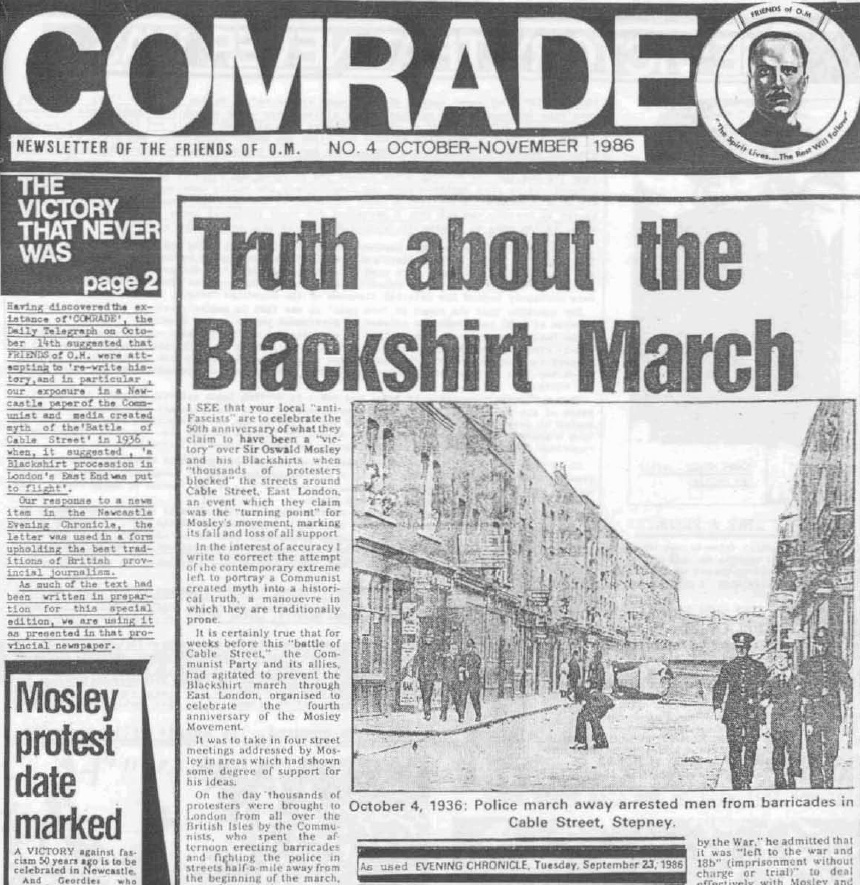
The most misrepresented event in the history of British fascism and ‘anti-fascism’ occurred 89 years ago today. The X account @ukipperlad has recently highlighted some of the historical lies told about this episode, and today we reprint the account published in 1986 by the Mosley veterans’ journal Comrade to commemorate the 50th anniversary of the much mythologised ‘Battle of Cable St’. We would also recommend interested readers to consult three books that while not by any means written by Mosleyites, do attempt to give a well-researched and accurate account of these events. The classic biography Oswald Mosley by Robert Skidelsky; East London for Mosley, by Thomas P. Linehan; and Hurrah for the Blackshirts!, by Martin Pugh.
On 23rd September 1986 the Evening Chronicle (a regional paper in NE England) published this correction by John Warburton, a BUF veteran then using the pen name John Christian.
Truth about the Blackshirt March
I see that your local ‘anti-fascists’ are to celebrate the 50th anniversary of what they claim to have been a ‘victory’ over Sir Oswald Mosley and his blackshirts when “thousands of protesters blocked” the streets around Cable Street, East London, an event which they claim was the “turning point” for Mosley’s movement, marking its fall and loss of all support.
In the interests of accuracy I write to correct the attempt of the contemporary extreme left to portray a Communist-created myth into a historical truth, a manoeuvre to which they are traditionally prone.

It is certainly true that for weeks before this “Battle of Cable Street”, the Communist Party and its allies had agitated to prevent the Blackshirt march through East London, organised to celebrate the fourth anniversary of the Mosley Movement.
It was to take in four street meetings addressed by Mosley in areas which had shown some degree of support for his ideas.
On the day thousands of protesters were brought to London from all over the British Isles by the Communists, who spent the afternoon erecting barricades and fighting the police in streets half a mile away from the beginning of the march, apart from ganging up on any lone Blackshirts they could find and beating them up.
In view of this surrounding violence, the Commissioner of the Metropolitan Police, Sir Philip Game, banned the march and informed Mosley it would have to take place westwards – in the opposite direction. Mosley, law-abiding to a fault, obeyed the instruction.
A question asked at the time of “who paid” the vast amount of money to transport these thousands of “protesters” – many of them unemployed and without the financial benefits of today – has never been answered.
It was of course portrayed as a great “rising of East London workers against Mosley”. Does one assume therefore that the Geordies who were there on that day were originally East Londoners who later moved to Newcastle and became accepted Geordies?
The truth of the matter is however that the invasion of traditionally patriotic working class East London by the Red mobs achieved the opposite of what they claim, for it proved to be a catalyst creating massive support for the Blackshirts.
Two weeks later thousands of East Londoners rallied to Mosley at enthusiastic mass street meetings, unadvertised and called at a few hours’ notice, without a sign of ‘protesters’ present on the day they ‘stopped’ Mosley.
Six months later, in March 1937, Blackshirt candidates polled nearly 20% of the votes in the LCC elections in the very boroughs where Mosley was to have held his march, and which had allegedly “risen against him”.
Even the Communist Daily Worker had to admit it a “disturbing feature”, and the Manchester Guardian reported it as “a surprising indication of strength”, and The Observer wrote “the size of the vote was a surprise”. That is fact – not myth.
And three years later, only six weeks before outbreak of war, Mosley addressed 30,000 people at Earls Court Exhibition Hall in what was described as the largest audience ever to attend an indoor meeting anywhere in the world, persuading Cassandra of the Daily Mirror to suggest it “a considerable achievement” and that “there was no doubt that the adherents …are increasing.”
Finally, and nearer the truth, if the view of the leading left journalist of the day, Hannen Swaffer. Writing in World’s Press News in 1943 under the heading of “Saved by the War”, he admitted that it was “left to the war and 18b [imprisonment without charge or trial] to deal effectively with Mosley and his Movement,” concluding: “Yes, but for the war we might have been a Fascist country.”
So whatever else the latter-day lefties of Tyneside and District Anti-Fascist Association are celebrating on October 4th, the “victory” over Mosley half a century ago is a “non-event”.
Perhaps they should celebrate the deaths of innumerable numbers of Mosley’s Blackshirts whose bones lie scattered over three continents fighting for their country in a war they had tried to prevent, while many of their “anti-fascist” opponents had tried to sabotage the war effort when Stalin was on the German side, and only discovered their loyalty to Britain when their Soviet fatherland became endangered.
_____________
The anniversary edition of Comrade continued with the following article:
The ‘Victory’ that never was
Prostituting that great phrase of the French armies before Verdun in 1916 – “They Shall Not Pass” – the Communist Party and its Labour allies, after weeks of agitation, mobilised a mob armed with every conceivable sort of weapon, imported from all over Britain and including a nucleus of Soho and Stepney gangsters, to mass and block the narrow Cable Street and areas around the start of British Union’s fourth anniversary march on 4th October 1936, persuading a weak Commissioner of the Metropolitan Police to back the lawbreakers and direct the march westwards, away from the mob and the streets where Mosley was due to speak, and where it had been shown he had some support. It is very unlikely that the Commissioner, Sir Philip Game, made the decision independent of a government directive. A total surrender of the hard-won freedom of assembly and free speech to anarchy and mob law. A precedent for their political heirs of today in their surrender to the mobs at Handsworth, Bristol, Brixton, Toxteth, and the Broadwater Farm estate.
According to Pat Devine, then Lancashire district Communist Party and one of the mob’s organisers, writing in the Morning Star, “a million leaflets were issued, hundreds of posters printed, and hundredweights of chalk were used to paint London white.” He did not mention the costs – including the transporting of his mobsters to London – and the ‘expenses’ for the unemployed, but they were certainly beyond the internal finances of the Communist Party.
The question that was asked of ‘who paid?’ is one that is unlikely ever to be answered, in the absence of a 30-year rule for release of government papers in the Kremlin.

The Daily Worker at the time hailed it as a victory for “East London workers” who had “spontaneously risen against Mosley”, and has sought to perpetuate the myth that it marked the end of support for Mosley and British Union, a view which is not in accord with the historical facts, but which has been so recorded by those who control the channels of communication. The union of mob and money.
That a blanket censorship in press and radio of British Union activity existed during the final years of the Movement’s history is now admitted, and it is therefore not surprising that for a number of years after the war, studies of the period by the new generation – even those starting from a neutral basis – drew the conclusion of British Union’s decline when faced with this lack of reportage in the files of the national press and other sources of information.

It is only in recent years that the newer academics – Professor Robert Skidelsky and others – penetrated this barrier of disinformation with meticulous study of government papers and other sources of information. They have given an alternative view on the ‘Battle of Cable Street’ and its relevance to the history of British Union.
A biased informant, but one who in the circumstances must be noted, is communist Lou Smith, one of the mob’s organisers, who it could be said has ‘let the cat out of the bag’. According to the Morning Star on 6th October 1986, he “reminded people that much of the organisation was done by the Stepney branch of the Communist Party”, and “that contrary to general opinion the mass turnout had not been spontaneous.” Another to Siberia!
Far from marking the end of British Union, 4th October 1936 “stood out in the minds of those fine lads that are gone, and those that still remain, as one of the greatest days in the Movement’s history”, according to the former Limehouse BUF District Leader Arthur Mason in an anniversary message from Australia.
British Union came to an end at the topmost peak of its eight years of struggle and sacrifice in the interest of the survival of the British people – by the imprisonment without charge of its members, and the outlawing of its normal legal activity. In a war which it had tried to prevent, and which has reduced our country to a shadow of its former influence, its heritage destroyed and unable to defend itself – British Union saw its own East London supporters decimated by enemy bombing at home, and the supreme sacrifice of many of its East London boys in the armed forces overseas.
But its place in history is assured. Its spirit will never die.
On Sunday 11th October the communists and their allies held a ‘victory’ march through East London, which turned into a fiasco. Led by police through the back streets, they nevertheless had to cross main thoroughfares where they were met by the real East Londoners, whose roars of derision and mocking laughter drowned the discordant blare of the Reds’ bands, and the resounding shouts for Mosley from thousands of lips mocked their pathetic attempts to sing the Internationale as they shuffled off to a quick dispersal.
There was no violence. They were just laughed off the streets in a good old British way, and East London was reclaimed for the British. They had initiated mob law against the people of East London, and had sparked off a great surge of support for Mosley and his Blackshirts throughout East London.
A week later came the moment of truth. Through the backstreets of East London the rumour spread like a forest fire that Mosley had said that within a fortnight he would march at the head of his Blackshirts through East London, and the press had described the tension and excitement as the late autumn nights brought the first hint of winter.

And in the second week after his so-called defeat, they turned out in their thousands to support Mosley and to take part in one of the greatest Blackshirt demonstrations seen. Rallied by word of mouth, Mosley turned up in Victoria Park Square, Bethnal Green, and spoke to a cheering crowd packed from end to end, and afterwards led a march to Salmon Lane, Limehouse, where he again was heard by a crowd of many thousands, with very few uniformed Blackshirts present.
The march had been banned, but when Mosley said he was going to walk to Limehouse, and most likely the crowd would follow, as they did, the police withdrew the ban, and the great march began, followed by some of the most extraordinary sights ever seen in East London.
Along the three mile route boys, young men, old men, grandmothers, welcomed Mosley with “Good old Mosley!” and “Hail Mosley – White Man!” from the streets, the doors, the windows – and some had quickly found small Union Jacks to demonstrate their support.
“They tried to stop us,” said Mosley at Limehouse. “They said we would not pass – but you are seeing tonight that we shall pass. Britain belongs to us Britons – and we are going to see that we get it back.”
______
Old Blackshirts Remember
George Dunlop and I shared the running of Limehouse Branch, which was in Essian Street (writes Arthur Mason from Australia). A large room over stables, near Salmon Lane – one of the streets where Mosley was to speak.
We were rather a new branch, but had made more progress in a short time than any other, and were responsible for “holding the pitch”, an exercise which went on for seven days before 4th October. We had George, Duke Pile, and many other odd speakers who got up and got going every time the Reds approached to try and take over. By the end, some speakers were reading their speech from the back of bus tickets!
[PTR notes: 21st century readers must understand that the standard police practice at this time was to allow street corner speakers to maintain their “pitch” – but if they vacated it, it could be taken over by their opponents. Hence the importance of “holding the pitch” before any important event to prevent it being occupied by the enemy. In some areas the communists would attempt to seize the pitch by force and had to be fought off.]
A great number of our members were unemployed and lived in our large room for a week, so we had the numbers together at night, moving to and from pitch and headquarters to hold off the opposition when they raided in the late hours. It was tough at times, but we won.
Sunday was a tense day, and led by Teddy Brown who had slept in my bed in daytime for a week, several hundred members and supporters made their way to Stepney Green underground station for Royal Mint Street [which leads into Cable Street]: and as we left the Tube, the first out were attacked by hundreds of Reds wielding clubs with barbed wire attached. Several of our lads including Tommy Moran caught it, but Tommy put down about a dozen with his fists before going down from a blow from behind. Nevertheless we managed to fight our way through and join our comrades on parade.
After we left Trafalgar Square, our branch arrived back at Essian Street to find people lining up to join, and in the next two days we enrolled 600. Shortly after, the branch won £100 presented by O.M. for the fastest growing membership.
4th October 1936 stood out in the minds of those fine lads that are gone, and those who still remain, as one of the greatest days in our Movement’s history.

I would not have missed it for anything.
John Charnley, former Hull District Leader, takes up the story:
There never was a Battle of Cable Street, unless it was the mild effort of the police to prevent the erection of barriers on the route of our proposed march. Peter Whittam and I had taken two parties of Blackshirts from Hull and Leeds, travelling overnight in one of our Bedford trucks we nicknamed ‘agony wagons’. When we arrived, a street fight was already in progress.
We won that scrimmage and eventually made our way to the main assembly point. It has always surprised me that in the heat of battle fear is seldom experienced, but the example and sheer guts of Tommy Moran on that occasion is an event which never loses its clarity. He was a great fighter, and on such occasions was a source of inspiration.
For the 17-year-old Johnny Warburton, it really was a ‘baptism of fire’, for it was his first Blackshirt march, and the first time he had seen his Leader. He writes:
I had been in London only six weeks, having spent the previous three years as a lone semi-active Blackshirt in a small Lancashire village. I had joined the BUF at 14, saying I was 16!
On the day heading to Tower Hill by underground with a group of my new comrades from Clapham Branch, we landed a coach packed with Reds bound for the same destination. Much abuse and fighting talk ensued, but they would not take us on – probably because they only outnumbered us by about three to one.
On arrival there were Blackshirts everywhere and as we lined up, along the ranks came the head-bandaged, bloody, smiling Tommy Moran, whom I knew slightly from the North, and with him (out of uniform) Bethnal Green’s Blackshirt Colman ‘Fatty’ Fields, who made some joke on Tommy’s appearance.
After the Leader’s inspection, the march westwards, and the dismissal, many of us made our way to National HQ in Great Smith Street, where Mosley appeared at an upstairs window.
“We never surrender,” he said. “We shall triumph over the old parties of corruption because our faith is greater than their faith, our will stronger than their will, and within us is the flame that will light this country and will later light the world.”
It was no surprise to see that Tommy, as I learned later, had downed so man opponents – both before and after his injury. His skill and courage in such outnumbered battles – the normal chosen practice of our courageous Red opponents – was legendary. He was in fact very light on his feet for his weight, and it was a picture to see him walk into a crowd of attackers, as if marching on parade, with swinging arms – except that each time his arm seemed to come up a little higher, reaching shoulder height without effort, and each time a body would fly away with great force. He would go through them like a knife, then turn around and repeat the performance.
In later years I grew to know Tommy well and I feel he was one of those earliest Blackshirts whose whole health suffered permanently due to the later wartime imprisonment: those that knew him will always remember the tough but gentle Tommy with deep affection.
Pat O’Donegan, former Shoreditch Blackshirt, who received minor injuries when attacked going to the march, says that:
The memory of 50 years ago dims with time but anger at being denied our right to march through streets previously traversed freely by East End members and supporters of British Union has never abated.
The area of assembly and the planned route of the march were not particularly Jewish areas, but through districts that were suffering much unemployment and poverty, and the ‘Bloody Sunday’ of Communist coinage might have been bloody in fact, but for Oswald Mosley’s lawful compliance with the police order to call off the march – for the mood of the Blackshirts would have taken them through the barricades with their bare fists.
Those few of us who remember that 4th October remember it with pride, as we do the Leader who still marches in spirit with us.
Fred Shepherd, a young Blackshirt cadet, recalls helping Shoreditch Branch “hold the pitch” at Aske Street, where the Leader was to speak:
When the news came through that the march and meeting had been banned, we had an impromptu march to Victoria Park Square, Bethnal Green – another speaking point, where there was a large crowd. Blackshirt discipline ensured that the crowd ultimately dispersed in good order, although feelings were running high.
Fred Bailey, though only a schoolboy, recalls helping Bethnal Green Blackshirts “hold the pitch” at Stafford Road, Bow:
I had hoped to see my father (former Labour Party stalwart turned to Mosley, Jack Bailey) proudly marching to the meeting with the Blackshirt column.
Driving in Cable Street recently with my 15-year-old grandson, he casually told me that he had learned all about “it” at school. Asked to explain himself he said that it was here that the workers of East London defeated Mosley and his Blackshirts. Here it was that East Londoners massed in their thousands to stop Mosley and his Blackshirts.
I said I would tell him the true story and I told him of the left-wing rabble and imported thugs, and the police banning of a legal march, and Mosley’s adherence to the law. And how between them, what they had achieved was to stop English men and women marching in their own streets.
The same men who 20 years earlier had been marching through the fields of Flanders, with every medal of distinction won for bravery, and the same younger men who three years later were to fight and die in another war, which they had tried to prevent.

