
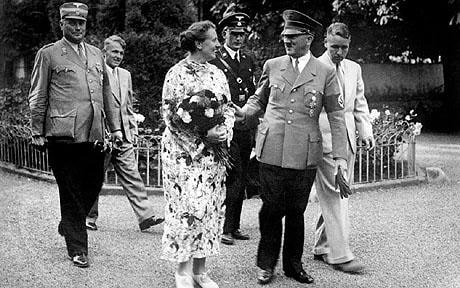
This weekend the Bayreuth Festival began its 150th anniversary season. One of the summits of European culture, Bayreuth’s Festival Theatre was founded by Richard Wagner to present his operas – or what he termed “music dramas” – with the financial support of King Ludwig II of Bavaria in the 1870s.
Esta entrada del blog también está disponible en español.
During the first half of the 20th century Wagner’s British daughter-in-law Winifred Wagner was in charge of Bayreuth and became a close friend and supporter of Adolf Hitler. Until his death in 1927 Wagner’s British son-in-law Houston Stewart Chamberlain was also closely associated with Bayreuth and was an important ideological influence on the future Führer.
Even in the late 20th century members of the Wagner family with connections to the Third Reich continued to be involved with running the Bayreuth Festival and well-known national socialists such as SS General Karl Wolff frequently attended.


However, since Wolfgang Wagner’s retirement in 2008 and death in 2010, the Festival has become ever more ostentatiously ‘anti-nazi’.
This weekend’s anniversary showed Germany’s 21st century political elite simultaneously at their best and their worst.
By comparison to Britain (let alone the USA) German politicians retain a commendable devotion to European high culture rather than crass populism. Chancellor Friedrich Merz and his predecessor Angela Merkel, as well as the head of the Bavarian regional government Markus Söder (leader of the conservative CSU) were all present.
Yet, even more than usual, this 150th anniversary was the occasion for obsessively ‘anti-nazi’ statements, beginning with opening remarks by the composer’s great-granddaughter Katharina Wagner who is now in charge of the Festival. She made a point this year of working closely with the Zionist propagandist Michel Friedman.
In 2003 Friedman had to resign as president of the European Jewish Congress, after he was convicted of possession of cocaine in a scandal that also included his use of women who had been trafficked into prostitution. In normal cases this would have ended someone’s career – but Friedman is a prominent Jew and this is Germany, so while shunned by many of his fellow Jews, Friedman is still treated as a hero by gentile Germans who feel the need to debase themselves before Zionist spokesmen.
Hence Friedman was at Katharina Wagner’s side yesterday, welcoming VIP guests as though he were the co-proprietor of the Festival.
Chancellor Friedrich Merz made a long speech after the concert had opened with Wagner’s prelude to Die Meistersinger. On the one hand, we must admit that this speech was at a far more elevated level than one would get from today’s Anglo-American political leaders. Yet on the other hand, it was replete with ‘anti-nazi’ obsessions, this time from a specific German conservative perspective, with several important references to the exiled novelist Thomas Mann.
Conservative opposition to the Third Reich is a very important subject worthy of detailed study, and one aspect of this which also has special relevance to Thomas Mann will soon be addressed in a forthcoming article at the Real History blog.
In the meantime, H&D readers who understand German will find yesterday’s broadcast (click here for broadcast link) of special interest. Those who don’t speak German can skip the speeches and enjoy the performance of some of the greatest music ever written, beginning with Wagner’s Meistersinger Prelude, followed by the ‘Entry of the Guests’ from Tannhäuser and ending with Beethoven’s Ninth Symphony (which as some readers will remember was also performed at the reopening of Bayreuth in 1951).
One thing we do know: European culture will survive and will be the foundation of Europe’s political renaissance, as our comrade Isabel Peralta emphasised in the short video below, filmed in Vienna and accompanied by Wagner’s music.

