
The recent federal indictment of an ‘anti-fascist’ and mainly Jewish organisation – Southern Poverty Leadership Conference (SPLC), which despite its name doesn’t have roots in the southern states of the USA, and certainly isn’t poor! – seems to signify a serious split between the Israeli government and its allies in the Trump White House on the one hand, and diaspora Jews (often liberal-leftist) on the other.
[Dieser Artikel ist auch in deutscher Übersetzung unter diesem Link verfügbar.]
[Este artículo también está disponible en español en este enlace.]
For some readers this will seem puzzling. Why are ‘the Jews’ now turning on themselves? Is there any such thing as a monolithic Jewish political ‘conspiracy’ – or are there in fact numerous conspiracies undermining the White world, several of which have disproportionate numbers of Jews in their leadership, but which are sometimes at odds with each other?
I and my colleagues at Heritage and Destiny magazine know the identity of some of the SPLC agents referred to by code numbers in this federal indictment, and before long we shall be exposing and discussing their record in detail, especially as these agents involved themselves in undermining British and European nationalism as well as attacking their more immediate target – the National Alliance, Dr William Pierce’s organisation that for decades has been one of the most serious and committed defenders of White interests worldwide.
To begin with, however, it’s helpful to look back to one of the earliest and highest level trans-Atlantic campaigns of anti-White political subversion, conducted during 1947-48 by the covert intelligence arm of the American Jewish Committee (AJC), which unlike SPLC was rooted in the pre-Zionist elite of the US Jewish community.
Just as with SPLC, the AJC’s intelligence operations briefly came under official scrutiny thanks to dedicated work by a small group of conservative congressmen, but these investigations quickly fizzled out and the ‘America First’ tradition soon emasculated itself, allowing the establishment wing of US conservatism to become slavishly Zionist. The true story can only now be reconstructed through careful examination of archives on both sides of the Atlantic. Some of these official documents began to be released following a Freedom of Information request by this author in 2013, having originally been ordered sealed until 2050, though two pages from the most relevant file will remain secret until 2031 or later under the so-called 75-year rule governing certain official secrets.

In the autumn of 1947 Sir Oswald Mosley was preparing his long-awaited political comeback. We now know that after the internment of Mosley and many of his leading officials, MI5 conducted an elaborate wartime infiltration of the entire nationalist scene, targeting both Mosleyites and other pro-German, anti-war, or anti-Jewish groups. This infiltration was directed by MI5’s B.1 section, headed during the war by Lord Rothschild: its star agent was Eric Roberts, a former bank clerk who assumed the fake identity of ‘Jack King’, posing as a London representative of German intelligence and recruiting an entire fake network of saboteurs and informants who thought they were working covertly for the German cause.
Postwar Rothschild returned to civilian life, but the anti-fascist spy network continued to be run by his former MI5 assistant Tess Clay. (She was the cousin and sometime mistress of another Anglo-Zionist intelligence officer Richard Meinertzhagen, and she should not be confused with her friend and colleague Tess Mayor, who became Rothschild’s second wife.)
During immediate postwar years, published files suggest that MI5’s monitoring of Mosley was mainly handled by two different sections. Miss Clay and her successors at B.1 continued to run the Rothschild / Eric Roberts network created in wartime, often picking up information from sub-sources who had no idea that they were working for MI5. Meanwhile F.3 was a combination of informants and analysis of mail and telephone intercepts that targeted Mosley and a small number of his chief lieutenants.
During 1947-48 MI5 also had a much higher-level spy inside Mosley’s organisation: a man whose identity the British secret state still tries to protect almost eighty years later! Their efforts to protect this agent led to serious complications when the AJC’s spies threatened to expose him – as this article will explain.
Wartime 18b restrictions on Mosley were revoked in May 1945, though he was denied a passport until June 1949. In those days, being refused a passport didn’t prevent a British subject leaving the UK (or returning to the UK) whenever he wished, but it was entirely up to other countries to decide whether they would admit someone without a passport, therefore lacking one was a serious inconvenience.

What both MI5 and anti-fascists were keen to learn was whether and when Mosley would return to public political activity. During the first two years after the war he moved cautiously, as he was well aware that his anti-war stance and internment would make his name mud among many Britons, though he was also certain (long before this was acknowledged by most politicians) that Britain and Russia were natural enemies and would soon be embroiled in some sort of war – this eventually became a forty-year Cold War but in 1947 looked likely to develop fairly quickly into a hot war.
In 1945-47 various book clubs and local organisations sympathetic to Mosley were created, but the leader’s main interest was trying to develop an elite cadre and publishing network, including building up anti-communist connections across Europe. For this he would need serious money, and it was this need for money and hope for American conservative backing that Jewish agents set out to exploit.
On 14th July 1947 a Chicago businessman calling himself Charles Morey wrote to Mosley from Quebec, saying that he had just spent a couple of hours in discussion with the French-Canadian national socialist Adrien Arcand, who had given him Mosley’s address. Morey said he would soon be in London on business, and would “deem it a privilege to meet with you and other nationalists, as time permits.”
Morey was the first of several fake American “friends” to contact Mosley during 1947-48. In reality he was Arthur Derounian, an Armenian immigrant best known under the pen name John Roy Carlson, who carried out a large-scale infiltration of pro-German and anti-war movements in the USA during the late 1930s and early 1940s leading to a sensational book published in 1943, Under Cover: My Four Years in the Nazi Underworld of America.
This careful approach to Mosley via Arcand (who seems to have been somewhat naive and exploited by several enemy agents), was part of Derounian’s main postwar project: an infiltration of both European nationalist groups and pro-Arab organisations which Derounian and his Jewish paymasters believed were recruiting mercenaries and buying arms in Europe for their coming war with the Zionist state that was going to be founded in 1948.
A year before contacting Mosley, but again using this fake identity ‘Charles Morey’, Derounian had written to two leading British anti-Jewish activists: Mosley’s longtime rival Arnold Leese, and Robert Gordon-Canning, a sometime supporter of Mosley’s who was especially closely associated with the Arab cause and whom a well-informed observer would have put near the top of any list of European fascists likely to give serious help (including arms dealing) for a putative anti-Zionist Arab coalition.
In April 1946 MI5 wrote to the FBI’s London Embassy liaison officer, hoping to find out more about this mysterious American businessman, but there is no evidence that the FBI tipped off MI5 about his true identity (even if they knew it themselves at that point). As late as January 1948 a high-level MI5 document was still describing this fake Morey as “a well-known Chicago fascist”.
However, in early 1947 a New York based anti-communist and ‘America First’ journalist called Joseph P. Kamp had already exposed ‘Morey’ as an imposter. It’s probable that Mosley knew this at a fairly early stage, but he did get taken in for a while by a more professional infiltration run by the American Jewish Committee. It was this second infiltration that developed into one of the strangest stories in the history of British fascism.

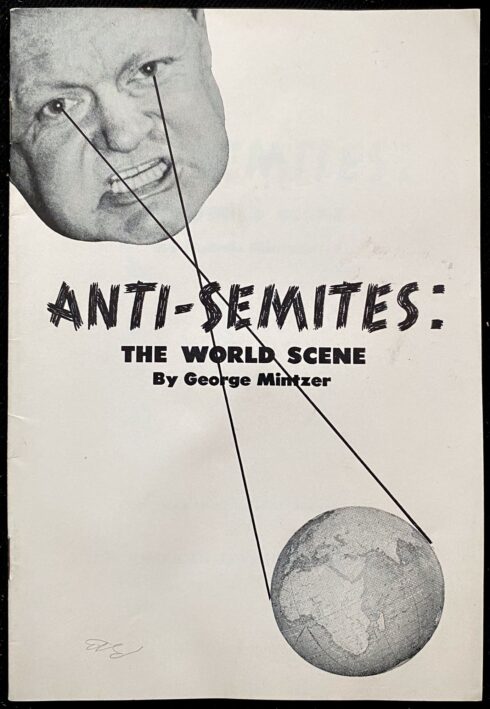
In the autumn of 1947 Wilson Warren Colby, a businessman with offices on Broadway, New York, began corresponding with Mosley. Just like ‘Charles Morey’, Colby was a fake – in this case created by George Mintzer, a former federal prosecutor who was head of AJC’s covert intelligence arm. Unlike Derounian, the SPLC, and many other ‘anti-fascists’ down the years, Mintzer and the AJC made a point of cooperating closely with the FBI and with the FBI’s semi-equivalents in London, Scotland Yard’s Special Branch. This Special Branch connection also involved the security and intelligence arm of the Board of Deputies of British Jews.
However, for various reasons and creating complications that I will discuss later in this article, Mintzer did not cooperate directly with MI5 and MI6, who during this exact same period were still involved in an anti-terrorist war against other Jewish groups both in Palestine and internationally.
Using his ‘Colby’ identity, Mintzer pretended to be an American sympathiser and offered to try to find a US publisher or distributor for Mosley’s latest book The Alternative. In November 1947 he sent an agent to London. This was Horace Schmahl, a New York private detective from a (non-Jewish) German immigrant family who was later to involve himself in numerous political ‘dirty tricks’ operations, sometimes with links to the FBI.
Perhaps fearing that if he spent too long in Mosley’s company his cover would be blown, Schmahl pretended he had been involved in a car accident in London and quickly returned to the US, but Mintzer built on this initial personal contact and continued to build Mosley’s trust in his supposed new American allies.
The purpose of this brief personal contact between Schmahl and Mosley was to obtain confirmation that Mosley had already been promised some financial support from wealthy Americans and was hoping for more. Mintzer and the AJC were determined to disrupt these incipient connections and to set American and British right-wingers at odds with each other. If there was to be a trans-Atlantic alliance between militant anti-communists, the Jewish lobby wanted to ensure that serious fascists and national socialists were kept out of it.

In February 1948 Mintzer sent a second agent to London, this time another New York private detective and ex-FBI agent called Tom Tracy who pretended to be ‘Colby’. (Tracy had played a leading role in pre-war operations against pro-German activists in the US.) Shortly afterwards Mintzer himself arrived, posing as a colleague of ‘Colby’ and using the name George Friedrich or Frederichs. They used Special Branch contacts to book themselves into London hotels under their false identities.
Unlike lower-level infiltrators, Mintzer managed to obtain direct personal access to Mosley, by holding out the promise of large scale funding: his fake persona ‘Frederichs’ was supposedly a Chicago steel magnate with connections to fifteen other pro-fascist businessmen in that city. Already in 1948 Mosley was thinking of a multi-level operation. Ordinary followers would eventually be encouraged to join a revived political organisation – this is what in due course became Union Movement, a successor to the pre-war British Union of Fascists, though naturally with a policy programme attuned to the postwar world.
Certain other mid-level activists however would be encouraged not to waste their time immediately on a party that (in the short term) was unlikely to make much progress with British voters. Instead they should work their way into respectable organisations such as local business networks (‘Chambers of Commerce’) and other pillars of British society such as the National Farmers Union.
At a higher level still – and especially involving a small group of Oxford and Cambridge graduates who had not yet been ‘compromised’ by overt fascism – Mosley proposed setting up publishing companies that would produce books and journals aimed not at ordinary British voters, but at creating an elite cadre of Europeans who when the time was ripe (probably once it was clear that World War III was imminent) would take advantage of developing opportunities to rebuild a continent-wide movement akin to a postwar version of fascism and national socialism.
It was this publishing network that required funding – ideally American funding – not just because cash was needed, but even more importantly because the 1940s system of rationing essential materials (including paper) and strict controls on exchanging currency meant it was impractical to operate solely from a British base.
But Mosley was no fool. After his first face to face discussions with the supposed sympathiser and prospective donor George Frederichs, he soon realised there was something fishy about him. MI5’s own surveillance picked up comments that Mosley had made to a handful of confidants in his inner circle.
In one phone call recorded by MI5 on 24th February 1948, Mosley said that his American visitor seemed to be part of a “racket”, but added: “I think he is just trying a little private game of his own. I don’t think it is anything to do with anyone substantial.”

On the latter point Mosley was wrong. His visitor was very substantial indeed – none other than George Mintzer himself, the head of AJC’s intelligence arm, known officially as its ‘Legal Committee’.
Established in 1906 by elite American Jews, mainly in New York and other north-eastern cities, the American Jewish Committee’s mission was to campaign for the rights of Jewry worldwide, which in the early days principally meant in Russia as well as the USA. For decades it stayed aloof from the Zionist movement, fearing that Zionism would compromise their close connections with American politicians and might even encourage ‘anti-semitism’.
However, though avoiding any Zionist activism, individual AJC leaders had indirect ties to that movement. Its president from 1941-43 was Maurice Wertheim, a New York banker who married the sister of Roosevelt’s Treasury Secretary, the notorious Henry Morgenthau. Wertheim’s daughter was the famous Jewish-American historian Barbara Tuchman.
By the time Mintzer launched his covert operation against Mosley, the AJC has started to shift its perspective and was less hostile to the nascent Zionist project. Joseph Proskauer, a New York lawyer with close ties to the Democratic Party machine once known as ‘Tammany Hall’, was AJC President from 1943-49, and his successor Jacob Blaustein (a Baltimore businessman whose family firm once employed Joe Biden’s grandfather) reached an agreement with Israel’s first prime minister David Ben-Gurion. Henceforth it was accepted that American Jews were allowed to balance their ‘loyalty’ to the USA with an increasingly blatant alignment with Israel – especially when campaigning against anti-Zionism and equating it in many cases with anti-semitism.
Internal AJC documents in late 1943 suggested that at that point Mintzer and his colleagues were hostile to the ostentatious ‘anti-fascism’ of other less elite Jewish groups such as the ADL and the 1940s equivalent of the SPLC – a group called ‘Friends of Democracy’ that deliberately sought publicity by scaremongering about anti-semitism. As this document (clearly written either by Mintzer or one of his close allies) put it: “some find in the fight against anti-semitism a lucrative racket.”
Whereas these crude anti-fascist lobbyists often sought to throw mud at extreme conservatives – such as the newspaper proprietors Col. Robert McCormick (Chicago Tribune) and Cissy Patterson (Washington Times-Herald) – the AJC believed in a more subtle approach to try to win over establishment right-wingers and drive a wedge between them and more committed fascists, national socialists, and ‘anti-semites’.
The 1943 document is especially interesting because it attacks the undercover journalist Arthur Derounian (aka John Roy Carlson). Bear in mind that the document wasn’t intended for public consumption: it fell into the hands of British intelligence (or perhaps was deliberately leaked to them) at the end of 1943. By 1946-47 Derounian was (as we have seen) turning his infiltration tactics against British fascist targets, and by 1947-48 the AJC themselves were playing a higher-level version of the same game.
The fact that when Derounian suffered a fatal heart attack in 1991 he was researching at the New York library of the AJC – the very organisation that had disparaged him half a century earlier – suggests that at the same time as shifting towards an accommodation with Zionism, the AJC also shifted to a more aggressive stance against even conservative anti-semites, let alone radical ones: hence was happy to work with men like Derounian whom they had previously seen as too provocative.
What this should tell us is that the stance of ‘right-wing’ Jews in today’s Israel – who are happy to collaborate with Trump against the likes of SPLC – is similarly likely to be a shifting tactic dependent on circumstances.

In October 1947 – during the very weeks when the AJC was advancing its anti-Mosley plotting – Mintzer and his intelligence operations came under congressional scrutiny for the first and only time. This was in committee hearings chaired by Congressman Clare Hoffman, a Republican from Michigan. Together with one or two brave allies – notably Illinois Congressman Fred Busbey – Hoffman was prepared to attack federal officials for their cooperation with the AJC in what amounted to spying on American citizens and blacklisting them for their opinions.
Their committee’s investigation found that card indexes were held by the US Civil Service Commission containing notes on suspected right-wing subversives. The files often had the annotation:
“The above was copied from the subversive file in the possession of attorneys Mintzer & Levy, 39 Broadway, New York City, Room 3305. Their files were made up in cooperation with the American Jewish Committee and the Anti-Defamation League. The sources of this information must not be disclosed under any circumstances nor be quoted. However, further information concerning above may be secured by contacting offices of Mintzer & Levy.”
It was of course precisely the same Broadway premises – the offices of lawyers George Mintzer and Newman Levy – that were the headquarters of AJC’s infiltration operation targeting Mosley during 1947-48.
There’s insufficient evidence as to whether Derounian and Mintzer were already allies by this point. What we do know is that Mintzer was working closely with Sidney Salomon, a Manchester-born Jewish lawyer who was head of the closest equivalent British organisation to Mintzer’s: the defence committee of the Board of Deputies of British Jews. Via Salomon, he met with Tommy Thompson, deputy chief of the Metropolitan Police Special Branch, and explained his anti-Mosley mission.
On Mintzer’s arrival in London, a longstanding Board of Deputies agent and former Special Branch officer named Cecil Pavey was put at his disposal. Pavey was one of two long-term agents that the Board of Deputies ran inside the British fascist movement. The other was James Brampton, a retired Anglo-Canadian civil servant and active Freemason. During the chaotic period of 1945-48, Brampton flitted between various factions, including A.K. Chesterton’s 1940s version of the ‘National Front’ as well as the British League of Ex-Servicemen created by one of Mosley’s righthand men, Jeffrey Hamm.
However, until Special Branch put them in the picture, MI5 and the Home Office took the ‘Colby’ scam seriously as representing American fascists. It’s apparent from semi-censored Home Office files that the Home Secretary himself, Chuter Ede, and his officials even feared that there might be some truth in communist propaganda stories that high-level Americans were preparing to fund Mosley and other fascists so as to create a militant, pan-European, anti-communist alliance. (These Home Office files were to remain closed until 2050 but many of them were released after I filed a Freedom of Information Act request.)
Even after Special Branch had explained that the supposed fascists were in fact undercover Jews, the extent of official confusion in London is shown in an MI5 memorandum on 5th February 1948 in which David Scherr (an MI5 specialist on Zionist subversion) sought to clarify exactly which Jewish organisation was involved. Special Branch had made a garbled reference to the ‘American Jewish Congress’, but Scherr correctly inferred that the operation was actually being run by the American Jewish Committee.

MI5’s Harry Lee liaised with Special Branch to find out the truth about these fake American fascists, and on 23rd February 1948 he had a lunch meeting with Sidney Salomon of the Board of Deputies. A published version of the MI5 file attempts to redact Salomon’s name but does so incompetently, and I’ve been able to confirm that he was Lee’s lunch companion and informant.
Salomon explained that the Board of Deputies and AJC were working together to monitor Mosley’s attempts to raise money in the US. “At the right psychological moment” they would expose whatever donors he had managed to attract, so as to deter others. This is in effect what happened a month or two later.
MI5’s main concern (which of course they didn’t explain to Salomon) was that their own star agent in Mosley’s circle might be blown by these Jewish infiltrators. In an unfortunate coincidence this agent – the future Conservative MP Henry Kerby – was right at the centre of the proposals that Mosley was putting to his prospective American donors (both the real ones and the Jewish infiltrators).
Mosley introduced Kerby to his American visitors, explaining that this was one of his brightest young men and that he planned to put him in charge of a large part of his new anti-communist and pan-European ventures. ‘Colby’ then pressed Kerby for details of some of these European contacts.
Aside from the more obvious fascist and Falangist contacts in Italy and Spain, and attempts to revive semi-disguised forms of national socialism in Scandinavia and Germany, the American Jewish spies were especially keen to find out about Mosley’s connections in France. From a 21st century perspective this might seem strange, but ‘Colby’ and his fellow Jews had reason to suspect that Mosley was trying to build alliances with French anti-communists led by General Charles de Gaulle.
Some reports speculated that these links came via Mosley’s sister-in-law Nancy Mitford, who by this time lived an entirely separate life from her husband Peter Rodd and was based in Paris, continuing her affair with de Gaulle’s senior aide Gaston Palewski. It’s quite likely that the American Jewish infiltrators were keen to find out the extent of these connections. Palewski had helped de Gaulle to create his political party – the RPR – in April 1947, but during this period de Gaulle’s support fluctuated and he remained in opposition until temporarily withdrawing from active politics in May 1953. He didn’t return for another five years, until the Fourth Republic collapsed in May 1958 and de Gaulle came to power backed by a wide-ranging coalition, pushing through constitutional changes to create the Fifth Republic. By then Mosley’s political alliances in France were with decidedly non-Gaullist radicals.
Another international connection involving Kerby, and about which the Jewish infiltrators pressed him for information, was with the South African lawyer and right-wing leader Oswald Pirow, who for a time was Mosley’s closest international ally. Later in 1948 Kerby was sent to South Africa as Mosley’s liaison with pro-European elements during the early years of apartheid (even though Pirow soon found himself marginalised by the newly elected National Party). By this time Kerby was reporting to MI6 as well as MI5 and only a handful of documents from this period are available, but it seems likely that he helped cause splits between Mosley and Pirow, as well as building contacts in South Africa and Rhodesia that continued to be useful for his British intelligence work up to twenty years later.

Even in 2026 MI5 is trying to disguise the fact that Henry Kerby was their top agent inside Mosley’s organisation: they either delete his name from public records or refer to him obliquely as ‘Source Brit’. I have been pursuing this case for several years and will publish full details within the next 12 months: the implications of the Kerby case and the parallel case of Gerald Hamilton are exceptionally serious.
After wartime service with MI6, Kerby was Liberal candidate for Spelthorne at the 1945 General Election, but MI5 deployed him as an agent inside Mosley’s organisation from 1947. His first personal meeting with Mosley was in November 1947, a few weeks before Kerby’s 33rd birthday, when he was invited to lunch at Mosley’s London home, 39 South Eaton Place.
Mosley very quickly came to regard Kerby as one of his most talented operatives, together with a group of other young activists – sometimes of doubtful moral character, but of higher education and social standing than the average blackshirt. Others in this circle included the 29-year-old American-born socialite and journalist Alastair Forbes; the 23-year-old Catholic homosexual Desmond Stewart, later a biographer of Lawrence of Arabia; the 24-year-old Leicestershire businessman Noel Symington, son of one of Britain’s leading tinned-soup manufacturers; Philip Thomas, a 1948 Oxford law graduate who later became a well-known businessman; and Adrian Earle, yet another Catholic homosexual (with a somewhat notorious Oxford reputation) who combined obscure literary interests with a life of petty crime before his mysterious death in a Madrid hotel room on Christmas Day 1977.
This was an odd assortment of characters, with varying levels of commitment to the Mosleyite cause, but they had the education and social cachet to act as credible intermediaries for Mosley across Europe – if he could get the all-important American financial backing.
MI5’s main worry was that in trying to disrupt and divide those potential American backers, Mintzer and his Jewish spy network might undermine MI5’s own carefully constructed promotion of Henry Kerby into Mosley’s inner circle.
On 26th February 1948 the Deputy Director-General of MI5, Guy Liddell met with the head of B Division, Dick White, and two of White’s senior officers dealing with fascism – F.C. Derbyshire and Harry Lee. They called in Commander Leonard Burt, head of Special Branch: he was one of the few police officers whom MI5 trusted and respected, as he had worked with them during the war. They were less sure that Burt’s deputy, Superintendent Tommy Thompson, could be trusted.
For one thing, MI5 worried that by working so closely with Mintzer, Scotland Yard had put themselves in a position where “there might be awkward revelations at a later date – it might even be said that they were facilitating these Jewish agents to carry out espionage against Mosley in this country. On the other hand it might further be said that they were participating in what might amount to direct provocation.”
Liddell explained to Burt that Kerby was MI5’s agent; Burt in turn explained that Gerald Hamilton was acting as a paid Special Branch informant!

On 20th March 1948, Gerald Hamilton left for a month-long visit to the US representing Mosley in his dealings with various Americans, including one of the few genuine, sincere supporters and prospective donors, a New York based but British-born stockbroker, Frederick Cartwright. By this time Mintzer’s organisation – deploying another agent using the fake ‘Colby’ identity – had already visited Cartwright and gave him an invented story designed to discredit Hamilton in advance of his arrival.
In due course (after several trans-Atlantic telegrams to and from Mosley) Hamilton managed to persuade Cartwright that this story was false, and convinced him of his bona fides. Again, one has to read between the lines of various reports in the British archives, which try to disguise the fact that Hamilton too was a crook and informant, in his case working for Special Branch as well as having other shady contacts. What we do know is that his trip ultimately (and predictably) failed to raise much beyond a promise of a large donation from the Chicago newspaper owner Col. Robert McCormick.
Mosley continued for some months to have high hopes of this McCormick connection, but it eventually came to little or nothing and by the end of 1948 he had (unsurprisingly but belatedly) lost confidence in Hamilton as an intermediary.
Meanwhile the one genuine and potentially useful contact – with Cartwright – wasn’t as lucrative as Mosley had once hoped. Cartwright himself was at first prepared to help, but he wasn’t all that wealthy on his own account. He did have a network of potential sympathisers, including the aged Texan oil and timber tycoon ‘Judge’ William Armstrong, but both Cartwright and his network understandably panicked after it became clear the developing Anglo-American fascist liaison had been infiltrated, and especially after Mintzer rolled up his ‘Colby’ operation and denounced Cartwright and others to the FBI, resulting in their being visited by FBI officers (though not charged).
Another fundamental problem was Mosley’s choice of emissary, even aside from the fact that Hamilton turned out to be a police informant. American conservatives (especially in the southern states) were and still are a lot more Protestant and moralistic than the people Mosley was used to dealing with in Britain and Europe: therefore they were unlikely to take to Hamilton, who was (a) Catholic and (b) homosexual!
On 14th April 1948 Liddell had a private meeting with the Prime Minister, Clement Attlee, and explained “the attempt by the Jews in America to provoke Mosley into some financial arrangement with American big business. The PM was quite amused at this.”

Throughout his 1945-51 premiership Attlee had an especially close relationship with the security and intelligence services – more so than most prime ministers. Although he was strongly anti-communist and a lot of his discussions with MI5 chiefs were about communists and fellow-travellers, he also made a point of asking about British fascism, long after most people would have assumed it had become politically irrelevant.
A further typically eccentric security risk developed at the end of July 1948 when the Norwegian government gave Henry Kerby a medal – the Haakon VII Cross – related to his wartime intelligence work. Liddell went to see Sir Robert Knox, a Treasury civil servant who was secretary of the Political Honours Scrutiny Committee, and arranged for Kerby to be given an anodyne description on his medal citation as a “translator in the War Office.” A few weeks later Kerby was sent to South Africa where, as noted above, he continued working both for Mosley and surreptitiously for his MI5 and MI6 controllers.
By then this particular American Jewish infiltration of Anglo-American fascism had done its work. There were to be others of similar ilk – as the emerging 21st century SPLC tale demonstrates – but Mintzer’s infiltration of the Mosleyite scene was among the highest level operations of its kind, raising complications that the British authorities try to keep secret even in 2026.
On this blog and elsewhere I shall later delve further into those complications which involve some of the darkest aspects of post-war Europe.

