
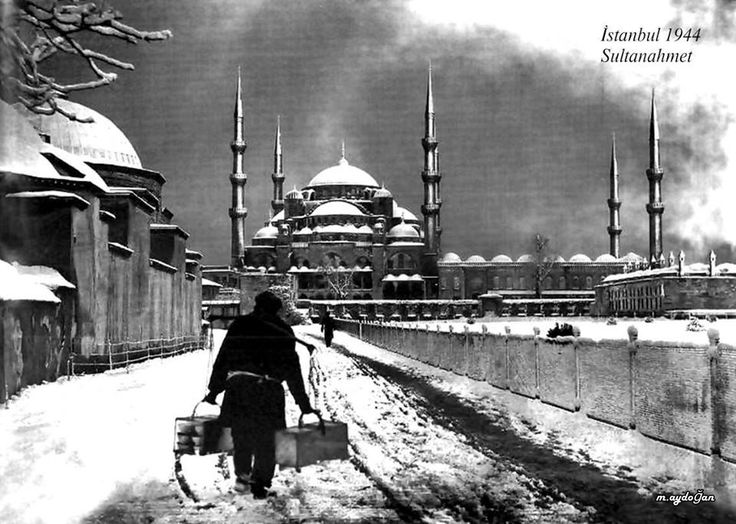
Two defections in the space of 18 months linked Kim Philby to Istanbul: a city that has long featured prominently in the annals of espionage.
[Dieser Aufsatz ist auch in deutscher Übersetzung erschienen.]
At the start of 1944 Erich Vermehren defected to MI6 from the Istanbul branch of Germany’s military intelligence service – the Abwehr. This helped trigger revolutionary changes at the top of Germany’s intelligence structure and accelerated plans by the reactionary conservative opposition in Berlin to attempt assassination of Adolf Hitler (culminating in the ‘bomb plot’ of 20th July 1944 that has been discussed elsewhere on this blog).
Then in September 1945 – within weeks of the Second World War’s end – Soviet intelligence officer Konstantin Volkov attempted to defect via British diplomats in Istanbul. This threatened to expose Philby and his comrades in the Cambridge spy ring, but Philby managed to warn his Soviet controllers in time. Volkov was dramatically kidnapped and flown back to the USSR, where he is presumed to have been shot.
In this article and the next one, I’ll reveal previously unreported aspects of the Vermehren and Volkov cases and some unexpected continuities between them, including how the Vermehren case illustrates some problematic aspects of ‘anti-nazi’ German conservatism. I’ll then return to another angle of the Philby story, in the next episode of my continuing series on essential Jewish aspects of the Cambridge spy ring.

On 1st June 1943 the journalist turned secret agent Eric Gedye sent a top secret telegram from Istanbul to SOE headquarters in London, telling his superiors that he had been approached by a dissident young Abwehr officer, Erich Vermehren.
Gedye thought Vermehren had chosen to approach him because he was well-known to educated Germans as a British journalist with strong ‘anti-fascist’ credentials – both as a pre-war Daily Telegraph correspondent in Vienna, and also as author of a strongly anti-Hitler book Fallen Bastions published on the eve of war in 1939.
Though he had longstanding connections to ‘anti-nazis’ – including Jewish communist circles linked to Philby in Vienna during 1934 – Gedye was also a veteran British intelligence officer. By the start of the war (and almost certainly earlier) he was part of Section D, the department of MI6 handling preparations for subversive warfare, which during autumn 1940 evolved into SOE.
In this capacity Gedye organised Austrian émigrés in Cairo into a Free Austrian Committee, founded in March 1941, which he used to send agents into Austria and try to rebuild communist and socialist networks. He was later based in Istanbul where in March 1942 he and his mistress (and future wife) Litzi – a Viennese Jewess, like Philby’s first wife who was also called Litzi – were arrested and thrown out of the country for a short time, after being accused of plotting to assassinate the German ambassador, Franz von Papen.
Yet during May 1943 one of Papen’s own Embassy staff – and not just any diplomat, but the young Abwehr officer Erich Vermehren, who had only been in Istanbul for a few months – made this covert approach to Gedye, via the editor of a Turkish newspaper who was one of Gedye’s longstanding contacts.

SOE headquarters noted the likelihood that Vermehren “might be sounding the ground for compromise peace feelers on behalf of some anti-Hitler Army group”. The question of how to handle such approaches had been debated at the highest levels of SOE the previous autumn (i.e. around September 1942) when two of the leading specialists on Germany from the British subversive propaganda agency PWE – Richard Crossman and Duncan Wilson – suggested forming “a joint committee for the study of peace feelers”. This proposed committee would comprise themselves from the propaganda side, and colleagues from SOE on the sabotage and subversive warfare side.
Crossman was yet another elite Englishman who (like Philby and Gedye) had married a Jewess, in his case a very brief pre-war marriage to a German divorcée called Erika. Like his colleague Wilson, he was an academically brilliant product of the elite public school Winchester, before Oxford, then wartime intelligence service. While Crossman went on postwar to be a Labour MP and government minister, Wilson became a career diplomat (eventually British Ambassador to Moscow, 1968-71).
Yet in the autumn of 1942, Crossman and Wilson were viewed by SOE’s more conventionally-minded bosses as a little too clever for their own good. SOE’s chiefs felt that peace feelers from Germany should be treated with suspicion, as they seemed likely to be designed either as a foundation for propaganda from Berlin to suggest that Britain’s will to fight was weakening, or to divide Britain from her Soviet allies.
Significantly, SOE documents show that its future chief Colin Gubbins was at this stage “especially alarmed” by reports that PWE’s chief agent in Switzerland, Gedye’s fellow pre-war ‘anti-fascist’ journalist Elisabeth Wiskemann, was working with a prominent Dutch Christian, Willem Visser ‘t Hooft, who had close contacts with Christians in the burgeoning German ‘resistance’ movement.
One reason this triggered “alarm” rather than interest was that SOE and its various country sections had been instructed to refer all such contacts to the Foreign Office for guidance. It wasn’t SOE’s job to make policy, or to imply that they could offer any promises.

Nevertheless, in November 1942 another indication of peace feelers reached SOE from their agents in Sweden, where the renowned criminologist Harry Söderman had just returned from a visit to Berlin liaising on Interpol business with leading police officers. Söderman told Peter Tennant (an SOE officer based in Stockholm) that he had spoken to leaders of the Kripo (the German police force dealing with crime, as opposed to the Gestapo which dealt with security matters).
These men – including Kripo head Arthur Nebe – told Söderman they “had a complete plan and means of execution for the arrest of all leading nazis from Hitler downwards including the heads of the nazi police forces and the military heads of the internal security garrisons at a moment to be indicated by a password from the BBC. The plan necessitated cooperation by Britain in landing airborne paratroops at various centres in Germany, to assist the German police and to crush resistance.”
It’s clear from the context that this idea was a reactionary conservative plan for a coup against Hitler. There was no pretence that it would be widely welcomed by the general German populace, hence the need for it to be coordinated with the arrival of British paratroops to “crush resistance”! However, the idea was viewed with suspicion in London, and though something called ‘Operation Shelter’ based on Söderman’s contacts was eventually developed, it soon aborted.
Erich Vermehren – the 23-year-old Abwehr officer who contacted Gedye in early summer 1943 – also came from a conservative Christian background, though in his case with some unconventional ‘bohemian’ overtones. His father Kurt Vermehren was a prominent lawyer in Hamburg who by this time was separated from his mother Petra. Both parents were from prominent and wealthy families who for generations had done business in the north German ports of Lübeck and Hamburg.
Since the early days of the Third Reich – having started to live a separate life from her husband – Petra Vermehren became a journalist, first in Berlin, then as a foreign correspondent based in Lisbon from February 1941 working for a German military magazine, Das Reich. There is evidence in British files that she had a ‘bohemian’ and probably bisexual lifestyle, spending a lot of her time in nightclubs and casinos and running up colossal debts.
Several members of the Vermehren family and their circle seem to have combined various forms of religious piety with an unconventional lifestyle. Erich’s sister Isa, for example, was a very well-known prewar nightclub performer with lesbian tendencies, who postwar became a nun! Both Erich and Isa converted to Catholicism in 1938.

Erich’s Catholicism became an even bigger influence on his politics when he married Countess Elisabeth von Plettenburg, an aristocratic cousin of Germany’s leading Catholic conservative politician Franz von Papen. It was supposedly under his wife’s influence that Vermehren became convinced he should cooperate with the British intelligence services, though he seems to have had a ridiculously grand idea of the influence he would thus obtain in London.
He already had an Anglophile outlook. As a 19-year-old he had been awarded a Rhodes Scholarship to study at Oxford, but the outbreak of war in September 1939 (just weeks before what would have been his first Oxford term) made this impossible. Several books and articles give an earlier date for his Rhodes Scholarship and wrongly suggest that the Third Reich authorities blocked Vermehren from going to Oxford, but official documents make quite clear this is untrue. It was the outbreak of war, not any punishment for ‘anti-nazi’ politics, that intervened.
Due to a bullet wound sustained in childhood, Erich Vermehren was medically unfit for military service. Until his graduation in September 1941 he continued his legal studies at several German universities, then for just over a year from autumn 1941 until the start of 1943 he was a welfare officer attached to various prisoner-of-war camps. Certain files suggest he had long conversations with British prisoners at one of these camps that pushed him further in the direction of believing that German conservatives should overthrow Hitler in order to make peace with the Western allies.
At the start of 1943, Erich Vermehren obtained a diplomatic post in Turkey, officially as adviser to the assistant military attaché in Istanbul, Paul Leverkuehn, a lawyer who had worked closely for several years with Vermehren’s father Kurt and continued this association postwar. It was clearly Kurt Vermehren’s connection to Leverkuehn that got his son Erich this job, theoretically because Erich (though he had graduated less than 18 months earlier and had little experience of legal practice) had a certain amount of specialist academic knowledge of international maritime law.
Paul Leverkuehn (whose father and other ancestors used the more usual German spelling Leverkühn but who changed the spelling of his own name to Leverkuehn so as to make it easier for his American clients) is an important character in this story, whose true role remains mysterious even now. He had intelligence experience during the First World War, when in 1916 he was part of a daring espionage mission in the Middle East (on what was then the Turkish-Persian border). This almost certainly brought him to Hitler’s attention in later years because Leverkuehn’s superior officer on this mission (and on later intelligence work in Riga in 1918) was none other than Max von Scheubner-Richter, a very important early national socialist who was killed at Hitler’s side during the ‘Beer Hall Putsch’ in Munich in 1923.
By that time Leverkuehn was working in Washington as a legal adviser to the German-American commission handling wartime reparations and damages claims. In fact he spent the entire period 1923-30 in the USA, both as a diplomat and government lawyer but also with an interval during 1925-28 as a New York banker connected to the Jewish Warburg dynasty.

It was almost certainly during the 1920s that Leverkuehn became acquainted with a senior New York lawyer Edward H. Fallows, with consequences that were to be important for both Leverkuehn and Kurt Vermehren: I shall return at the end of this essay to this strange aspect of the story, involving one of the most bizarre frauds of the 20th century – the attempt to pass off a mentally disturbed Polish woman as Anastasia, daughter of Russia’s last Tsar Nicholas II.
An even more important and possibly sinister connection that Leverkuehn made in these New York days was with another Wall Street lawyer William Donovan, who was to become chief of Roosevelt’s wartime intelligence agency OSS (Office of Strategic Services), forerunner of the CIA. When Donovan travelled to Europe on a mission for Roosevelt in 1939, his old friend Leverkuehn was one of the first people he contacted in Berlin. (This was just before the outbreak of war, and the USA was to remain neutral for more than two years, but in the light of later events in Istanbul, this early Donovan-Leverkuehn connection is interesting.)
In 1930 Leverkuehn returned to Berlin and began a legal practice, at first in partnership with a Jewish lawyer named Simon Wolf. Though he prudently split from Wolf in 1933, it seems significant (viewed with hindsight) that at least two conservative lawyers who were to become leading anti-Hitler coup plotters worked for Leverkuehn as trainees or junior lawyers at different times in the 1930s: Adam von Trott zu Solz in 1934-35, and Helmuth James von Moltke in 1938-39.
Soon after joining the NSDAP in 1937, Leverkuehn burnished his national socialist credentials in 1938 by writing a laudatory biography of Scheubner-Richter.
At the start of the Second World War, given his earlier experience of serious intelligence work during the previous war, Leverkuehn was an obvious recruit to the Abwehr where he was assigned to the Middle East, first Persia and then (from 1941-44) Istanbul.
He also recruited his former employee Helmuth James von Moltke to the Abwehr: in this capacity Moltke continued to be one of the most active covert opponents of national socialism and founded a conservative opposition group, the Kreisau Circle. He was among the first of this type of opponent to be arrested (in January 1944) and was executed a year later.
It’s still not clear to what extent Leverkuehn was himself connected to these conservative opposition efforts to contact the Western allies, but we should bear in mind that he wasn’t a stupid man, and that successively his former employees Moltke and Trott, then his partner’s son Vermehren (who was by this time his own deputy) used Leverkuehn’s patch in Istanbul to make a series of approaches to the Americans and the British, and then eventually in Vermehren’s case to defect to the British.
Having discussed the character and record of his boss Leverkuehn, we should now return to Vermehren himself.

The June 1943 telegram from Eric Gedye to SOE headquarters is a mere fragment in the files. We know that London replied to Gedye on 2nd June that he should go ahead with the contact, and keep them fully informed, but we don’t know what transpired over the next few months.
The decisive shift in the Vermehren story has to be pieced together from partial and sometimes contradictory stories. It looks as though he waited until he had been joined in Istanbul by his wife Elisabeth before making a definite proposal to the British. Using Adam von Trott’s influence in Berlin, they persuaded the authorities that Elisabeth’s Catholic credentials and aristocratic cachet would be helpful in making contacts to certain American Catholics in Turkey who might be able to provide valuable information about US politics, including matters that might affect the 1944 elections.
More or less as soon as Elisabeth was safely in Istanbul, Vermehren made contact with an MI6 officer at the British Embassy. It seems that though the MI6 station chief was Harold Gibson, Vermehren made his first approach via the assistant military attaché Cyril Cribb – perhaps because Cribb was closer to his age and rank.
There are however other reasons why Cribb’s name has been written out of history, after he committed suicide in July 1944. The odd background to this suicide will be discussed in my second story on Istanbul intrigue – relating to the attempted defection of Konstantin Volkov. For now we should just note the disturbing fact that two important British intelligence officers from wartime Istanbul ended up committing suicide: Cyril Cribb in 1944, and his boss Harold Gibson in 1960. Gibson was a very senior MI6 officer, who was heavily involved in MI6 contacts with the Zionist intelligence service, notably Teddy Kollek (as I explained in a recent article). Gibson shot himself in Rome (where at the end of his career he had been head of the MI6 station) in August 1960, three years after retirement.
In mid-January 1944 Cribb introduced Vermehren to the most important player in his story – Nicholas Elliott, who had been Istanbul representative of the MI6 counter-intelligence branch Section V since spring 1942. For about a week Elliott ran Vermehren as an agent inside the German embassy, bringing out documents that were photographed before being returned.
The precise dates are still unclear, but at around the time of Vermehren’s first contact with Elliott, they learned that the Gestapo had started to arrest some of his old friends and contacts in the conservative anti-Hitler movement back in Germany. These arrests were the long-term outcome of a successful Gestapo penetration of this conservative ‘resistance’, in particular when a Gestapo agent managed to attend a party run by one of these elite ‘anti-nazi’ groups, the Solf Circle, in September 1943.
After waiting for four months and gathering evidence, Himmler ordered the suspects’ arrest in mid-January 1944. Quite obviously it’s not a coincidence that Vermehren defected around the same time. Most likely what happened is that he had been planning this for months, but once the arrests started he and Elliott decided it wasn’t safe to continue running him as an agent inside the Embassy.
Consequently a fake ‘kidnapping’ was staged to explain the Vermehrens’ disappearance. On 27th January (just a week after their old friend Moltke had been arrested) the Vermehrens were smuggled to Cairo via an MI6 base at Smyrna.

There’s some evidence that Vermehren deluded himself that the abduction story would be kept up as a cover for his disappearance, and that he could play some discreet but high-level role behind the scenes promoting his vision of ‘good’, ‘democratic’ Germany, without causing problems for his friends and family by having his defection made public.
His naive assumptions were shattered within weeks. On 10th February a British paper – the News Chronicle – named Vermehren as a German diplomat who had defected to Britain. Several other British newspapers (notably the Daily Mail) went on to highlight Vermehren’s Catholicism and his wife’s family connection to Papen.
On 3rd March (having been forced to accept that they might as well come clean) the Vermehrens – via their handlers at the British security and intelligence organisation SIME – released a statement broadcast on Radio Cairo denouncing national socialism.
We now know that much earlier, in fact within days of the Vermehrens’ disappearance, the SD – intelligence wing of the SS – had prepared a remarkably accurate assessment that was sent personally to Hitler on 7th February 1944 by Ernst Kaltenbrunner, who had been head of the RSHA (which combined the SD, Gestapo, and criminal police Kripo) since the start of 1943, following Reinhard Heydrich’s assassination in June 1942.
Kaltenbrunner explained to the Führer that there was “a nest of German traitors in Turkey” and that Vermehren had “for the past three months been engaging in treasonable activities on behalf of Major Elliott and Major Gripp [sic: obviously the SD report meant to refer to Maj. Cyril Cribb, see above] of British military intelligence. Vermehren further intends to carry on active anti-German propaganda over the London radio. The British plan to make a sensation of the case, especially as Countess Plettenberg is related to von Papen.”
That Kaltenbrunner report to Hitler (first discovered in Berlin archives by the historian and Spiegel journalist Heinz Höhne) is interesting on many levels, though I’m the first author to look seriously at the activities of Cyril Cribb, for reasons that will become apparent in my next article.
Quite obviously, the SD had access to serious intelligence about Vermehren’s relationship with the British, and we are entitled to wonder why this was so, given that Germany usually lost their intelligence war against Britain quite badly. We do know that Istanbul was apparently the scene of a rare German intelligence triumph, when in late 1943 and early 1944 a corrupt Kosovar valet, Elyesa Bazna, working for the British Ambassador to Turkey, Sir Hughe Knatchbull-Hugessen, stole documents and sold them to the Abwehr.
Bazna’s treachery – under the codename Cicero – became widely known after the war, but in the light of the Vermehren affair we are entitled to look on the whole situation with some scepticism. Based on gossip with old spies in various bars and gentlemen’s clubs, the journalist and intelligence historian Anthony Cave Brown long ago hinted that the Cicero case might have been a British deception operation in which false information was fed to the Abwehr, and this time he might very well have been correct.

It’s certainly curious that (though the Ambassador himself was one of those old-school diplomats who seemed clueless about intelligence matters), Bazna had first been recruited to the Embassy staff by a much more clued-up figure, the Ambassador’s number two Douglas Busk, a mountaineer and veteran of several tough operations who knew his way around the intelligence field. Moreover, by a strange coincidence, the supposed German spy Bazna quit during the third week of January 1944, at almost exactly the same time as the arrest of Moltke, Vermehren’s defection, etc.
While Vermehren perhaps sincerely believed that he was a major figure in his own right who was helping the ‘good Germans’ of the conservative right in their struggle against national socialism, it seems very likely that the main MI6 objective in promoting his defection was not to obtain intelligence but to cause chaos in the ranks of the German espionage services during the run-up to the invasion of Europe.
In my previous article I explained that the cultivation of Hungarian conservatives, whose discussion of taking Hungary out of the war or even joining the Allied side was crushed by German occupation in March 1944, was similarly part of Allied deception. While the German occupation of Budapest decisively prevented Hungary from changing sides, this was no loss to the Western Allies, who had absolutely no intention of invading Germany via the Balkans in any case.
Quite the contrary! Every German unit diverted from France and sent to the Balkans was a strategic victory for the Western Allies, because they were being taken away from what was always planned to be the main theatre of the closing stage of the war.
Similarly, MI6 knew perfectly well that Vermehren’s defection would lead to chaos and ultimately force German conservatives into attempting their long-delayed coup or facing the destruction of their power. Again, this was a strategic win for London and Washington, who had long ago decided they had no interest in discussing any reasonable peace terms, whether with Hitler, Himmler, or their conservative enemies in the German officer elite.
Incidentally, a much-underestimated factor among German conservative opponents of Hitler was homosexuality. In fact, one of the things anyone trying to look behind the headlines of 20th-century wars needs to understand is that homosexuality is overestimated as a factor in popular perception of the Cambridge spy ring (and of the Marxist and fellow-travelling British networks generally), but underestimated as a factor in conservative networks, whether anti-Hitler plotters among German conservative elites, or so-called ‘civic nationalists’ in today’s Britain.
The July 1944 ‘bomb plotters’ who tried to assassinate Adolf Hitler were in very many cases homosexuals. Similarly the networks of Abwehr conspirators who in some cases worked directly with British intelligence, in other cases with Jews or Soviet agents, were very often corrupt businessmen or homosexuals who had a history of dubious connections to Jewish criminals of various kinds.
Paul Leverkuehn, the Abwehr officer who gave Vermehren his job in Istanbul (due to being a close friend of Vermehren’s father) was described by the Viennese aristocrat and British agent Count Josef von Ledebur as having “strong homosexual tendencies”. Due to Leverkuehn’s record during the First World War of working with Max von Scheubner-Richter – who in 1923 became the most famous of the national socialist martyrs at the Munich Feldherrnhalle – he was given promotion in the Abwehr despite his own questionable politics.
Yet by the summer of 1943 reports that Leverkuehn was trying to contact Western Allies in Istanbul led to him coming under investigation in Berlin, and Hitler took a personal interest in his case.

One of the many mysteries of this period is how tolerant Hitler was of opposition circles, and especially of those who as he well knew were putting out peace feelers. Even in 2026 this is a subject much debated among serious historians. One factor seems to be that Hitler rightly believed the Western Allies and the Soviet Union were natural enemies who would sooner or later be in open conflict. Therefore if certain channels (even if they represented conservative political forces who had never been sincere national socialists) could open up just the possibility of discussions, that could be a good thing.
Provided of course that it didn’t flip into outright treachery – and by triggering Vermehren’s defection in 1944, MI6 tipped the balance. Two different biographers of the Abwehr chief Admiral Wilhelm Canaris take very different views on this. The left-wing German journalist Heinz Höhne believed that from as far back as summer 1943, Hitler had been furious at those making peace overtures to the West (including Leverkuehn). However, a more recent biographer, the former Times correspondent Richard Bassett who had extensive experience of Eastern Europe at the end of the Cold War, believes that Hitler was at least half-encouraging such peace feelers, and that the Führer’s fury and dismay came much later when instead of these conservatives patiently waiting for the West to give something in return, they merely gave up hope and defected.
A three-way split was by this time developing inside German diplomatic and intelligence circles. This in itself wasn’t surprising because from the earliest days of the Third Reich, aware of the precarious nature of his revolution, Hitler deliberately encouraged several competing tendencies within the bureaucracy rather than forcing them all into a single united line. Although national socialism was by its very nature anti-Russian, and Hitler was personally very anti-Russian indeed (not merely anti-Soviet but fundamentally anti-Russian in his view of geopolitics and Germany’s historic mission), he was prepared to tolerate a long-term tendency within some senior ranks of the conservative German officer corps that had been pro-Moscow since the early 1920s.
Foreign Minister Ribbentrop – a notorious Anglophobe – shared that pro-Moscow outlook, as did a certain section of those who by 1944 were plotting against Hitler, notably the former Rhodes Scholar and former employee of Leverkuehn’s law firm, Adam von Trott zu Solz. On some interpretations, Abwehr chief Canaris himself also had long-term and sinister links to Moscow.
Yet from Hitler’s strategic perspective, it was paradoxically a good thing for such tendencies to exist – and for the West to know about them. Hitler shared the essentially pro-Western outlook of Rudolf Hess and Heinrich Himmler, who each at different times made explicit overtures to Britain – in Himmler’s case continuing well into 1945. Yet the Führer knew that for any negotiation with the West to be fruitful, it would have to be clear that Germany wasn’t merely a supplicant – that although peace with the West would be preferable, it should not be unconditional and was not necessarily the only option.
This was the strategic background to Vermehren’s defection, and within days Ribbentrop and his Foreign Ministry allies made the first move in their three-way conflict against both Canaris and military intelligence on one hand, and on the other hand against Himmler and his SS empire (in intelligence terms meaning the SD under the RSHA umbrella).
Even before the Vermehren defection, there had been a strange incident in December-January 1944 when bombs exploded on two British ships carrying oranges from Spain. Though there were no casualties, this was an unnecessary and pointless provocation (if we assume it was indeed carried out by Abwehr saboteurs) and it was one of the main reasons why Hitler recalled Canaris to Berlin and dismissed him in February 1944. In other words, the most immediate reason for sacking Canaris involved doubts about his loyalty: Hitler could no longer trust the Abwehr to handle what by 1943-44 had become one of its most crucial and delicate tasks – trying to develop relations with Britain towards a negotiated peace.
The dismissal of Canaris precipitated a takeover of his Abwehr empire. The only remaining question for Himmler to decide at a conference on 12th February with his own top advisers (including Kaltenbrunner and Schellenberg) was how rapid and ambitious his empire-building should be.
Significantly, Himmler himself was cautious and thought his RSHA could only immediately “digest” sections I and II of the Abwehr, whereas Schellenberg wanted to move immediately to take over the whole of Canaris’s former territory; and Kaltenbrunner wanted to go further still, and incorporate even the intelligence side of Ribbentrop’s Foreign Office. Kaltenbrunner perceived that “the Foreign Office is trying to use the Vermehren and Co. affair to neutralise the German intelligence services, whose competition it finds irksome.”

At this crucial stage MI6 perceptions of developments inside the German intelligence services were influenced by not just one but two of the Cambridge spy ring. John Cairncross was at this point working in MI6 Section V, specifically on assessments of the threat posed by the SS intelligence arm, the SD. While Kim Philby was working his way towards succeeding as overall head of Section V, having for some years been running its Iberian sub-section.
On 15th June 1944, as MI6 assessed the bureaucratic fallout that their Vermehren propaganda coup had precipitated, Cairncross wrote of the danger that “the SD political espionage service (Amt VI) will probably represent a greater danger than the Abwehr.”
A similar assessment was made at greater length by one of the best minds in MI6, the Oxford philosopher Stuart Hampshire (who later came under probably unjustified suspicion of himself being part of an ‘Oxford spy ring’!). Hampshire was one of a small group of elite Oxford academics who were recruited by the historian Hugh Trevor-Roper to work on close analysis of the German intelligence service, partly based on codebreaking but supplemented by study of other sources.
A large part of Hampshire’s analysis was focused on whether these changes would make it harder or easier for the joint MI5-MI6 deception schemes to fool their German opponents, especially about the critical matter of the invasion of Europe via the Normandy beaches which had begun just nine days earlier, but which the deception teams were still trying to convince Berlin was only a lesser arm of a two-pronged invasion. However, in retrospect we can also read this analysis in light of the fact that defeated factions in German intelligence were about to try to assassinate Adolf Hitler.
With effect from 1st June 1944 (though decided during earlier weeks and months) the entire military intelligence structure of what had been the Abwehr was no longer responsible to the head of the Army (Field Marshal Keitel) but to Himmler, via RSHA chief Kaltenbrunner. In other words: “Himmler has had a complete and unqualified victory.”
One fortunate side-effect from the British standpoint was that their existing deception channels into the Abwehr might now be given heightened credibility and access to Hitler himself, because the reports would now be passed swiftly through the SD system rather than getting “pigeonholed” or stuck in the inefficient and sometimes corrupt Abwehr bureaucracy. One might compare this apparent paradox with the way that certain cancers will kill a healthy young man far more quickly than they would kill an elderly decrepit man. The very aspects of a younger man’s body that enable him to be vigorous will (once manipulated by cancer) kill him rapidly; whereas an ageing man would survive the same onslaught for much longer.
However, the downside from an Anglo-American standpoint was that the RSHA was more competent than the Abwehr in terms of counter-espionage, which presented obvious dangers. For example, Hampshire explained that “doubtful personalities of unproven loyalties in the Abwehr itself will be thoroughly investigated; this investigation has in fact already begun and, as we should expect, its first objects have been the Abwehr’s agents and officers of semi-Jewish origin – Hans Brandes in Lisbon, [Heinrich] Bitzer in Sofia [and Istanbul], [Richard] Klatt of the Luftmeldekopf Sofia. [Karl] Kühlenthal in Madrid who is of Jewish origin was made an honorary Aryan in 1941 in recognition of his services; the RSHA was naturally surprised and made enquiries. Like Brandes, he may need to be particularly careful, as he can no longer rely on Canaris’ friendship and protection. The intelligence supplied by those who survive the test may be more uncritically believed and circulated; but there will probably be a sifting period, which will be uncomfortable for everyone. The old Abwehr headquarters was easily content with the suspension of disbelief; its officers would cynically speculate about the reality or genuineness of their sources, deprecating any too thorough investigation. The same tolerance has been noticed in the Amt VI station in Lisbon, but not in the RSHA itself.”
Overall therefore the MI5-MI6 deception team’s “opportunities of undermining the [German] organisation will be rather less, but the rewards of success much greater”, as “the Abwehr under Himmler and Kaltenbrunner will become more effective and influential, and its agents will be encouraged to supply high-grade political intelligence.”

As for Vermehren, he had served his purpose in helping stimulate this internal chaos in Berlin, which had produced these positive and negative consequences.
During February-March 1944 interrogators from SIME (the joint MI5-MI6 organisation in the Middle East) interrogated Vermehren nine times, but close examination of the files on his case suggests to me that his main value was in propaganda rather than intelligence terms. SIME warned MI5 on 11th March that Vermehren was essentially a conservative: “while anti-nazi he appears to retain patriotic German sentiments. He or wife may later develop patriotic or religious scruples which may interfere with proposed employment.”
Pressure to employ the Vermehrens came mainly from Section V of MI6 (which focused on counter-espionage against the German intelligence services) and from the Political Warfare Executive (PWE), responsible for subversive propaganda against Axis nations. The Vermehrens were flown from Algiers to RAF Lyneham during the night of 18th-19th March, and for some weeks stayed at the Kensington flat of Kim Philby’s mother at 7 Grove Court, Drayton Gardens. (This was the same flat where the world’s press gathered in 1955 to hear Philby brazenly defend himself against what turned out to be true allegations that he was a traitor – but in 1944 it served as a far more discreet bolthole for the Vermehrens.)

For a short time in the autumn of 1944 the Vermehrens moved to the English countryside to work on propaganda with PWE, but by the end of that year their usefulness had ended. German conservatives of their sort were becoming an embarrassment to Britain as the war’s end loomed, and with it the inevitability of disappointing the reactionaries’ hopes and dreams.
This was made clear during secret top-level correspondence in mid-December 1944 when MI6 tried to enlist a well-connected MI5 officer (Derek Tangye) to obtain employment for the Vermehrens with the Daily Mail. Tangye’s boss at MI5, Guy Liddell, wrote:
“I feel bound to say that I do not feel very happy about the whole arrangement, either from your point of view or from ours. …Though they have every reason to be anti-nazi at the moment, and perhaps in some ways grateful to this country, [the Vermehrens] may very well in a year’s time not feel so well disposed towards this country. There is not the slightest reason for thinking that they are anti-German and they may, in due course, hotly resent Allied policy in their own country. I question, therefore, whether it is a wise move to get them dug into Fleet Street, where they would have every possibility of picking up information and might well try to influence the Press against the policy of the government of the day.”
During 1945 Liddell’s warning proved prescient, as the Vermehrens did indeed prove incapable of recognising that Allied policy was to split and disarm Germany, rather than build her up at the centre of some fantasy conservative Europe led by ‘good, anti-nazi’ Germans.
A semi-accurate but embarrassing parliamentary question by the maverick Catholic MP Richard Stokes implied that the Vermehrens and their allies were complaining about the way that British intelligence had treated the German ‘resistance’, and similar themes were picked up in the autumn by another maverick operator with connections to the intelligence scene and European reactionary networks, Kenneth de Courcy.
In the event it was the Vermehrens’ own indiscretion that got them into trouble. They wrote four letters to members of their family, and persuaded an Englishman called Creighton to take these letters with him to Germany on 12th October 1945, thus avoiding Censorship. Creighton was caught after handing this illicit correspondence on for posting via an airman at Hamburg when his plane touched down for refuelling on its way to Berlin (where Creighton was employed by the Allied occupation authority).
Far from having some role in advising Allied policy on the reconstruction of Germany, the Vermehrens were now considered to be an embarrassment. But there is evidence that while MI5 and the heads of MI6 wanted to send them back to Germany now they had served their purpose, a faction of ‘rightwingers’ inside MI6 were secretly lobbying on their behalf and continued to do so into the 1950s. Most intriguingly, it was this reactionary faction in MI6 that was close to Kim Philby, the key Soviet agent inside the organisation!
As had been the case for many years, the KGB wanted to ensure that its agents were close to the reactionary ‘far right’ in the West, and able to manipulate it to serve the Kremlin’s purposes (and if necessary to emasculate any true European ‘right’ – i.e. revived national socialism – that might emerge at any time).
By December 1945 the chiefs of MI6 (though perhaps opposed by their own ‘right wing’ faction) wrote that “attempts were made of course to find some occupation for [the Vermehrens] which would be useful to MI6 but this did not prove possible, largely owing to the fact that they were extremely ‘choosey’ and hedged violently over every implied acceptance of a proposal, so that we finally came to the conclusion that they were not prepared to commit themselves to anything whatever, although quite ready to accept commitments made by others towards them.
“Finally, my Department came to the conclusion that there was no justification whatever for keeping them in this country at government expense, and this coincided with various reports showing that they had been, if not actually indiscreet, at least unduly talkative. There have been, moreover, indications that they are prepared to make the fullest possible use of any influential social acquaintances to ensure that things go according to their wishes.”
These “influential social acquaintances” included the Catholic Archbishop of Westminster, Cardinal Bernard Griffin, who lobbied the Home Office on their behalf and mentioned that MI6 had been responsible for bringing them to the UK some 18 months previously.
Somehow – for reasons that aren’t made clear in the files – this influential lobbying succeeded in overturning repeated attempts by the Labour government (in line with the wishes of the heads of MI5 and MI6) to get the Vermehrens to move back to Germany. It’s possible that in some ‘deniable’ sense MI6 changed their policy and decided, with the onset of the Cold War, to make some use of the Vermehrens, but if so it’s extraordinary that at several points during the following years (most intensely during 1949-50) MI5 put Vermehren and his associates under surveillance.

For about 18 months during 1946-47, Vermehren taught at schools in Sussex while his wife taught at a Catholic school. Then, beginning in 1947, he was involved in a series of business and publishing ventures including European Digest, linked to one of many conservative and often Catholic factions promoting a form of European unity. There are a few scraps of evidence showing that in 1952, for example, Vermehren and his family socialised with Elma Dangerfield, a formidable networker with links to MI6 who created the European-Atlantic Group. As late as the 2010s I met one of Vermehren’s close relatives several times in such circles.
By the 1960s (when they were in their 40s) the Vermehrens had given up on the idea of becoming naturalised British citizens and moved to Switzerland, where they were active traditionalist Catholic conservatives defending and promoting the use of the Tridentine mass after it started to be discouraged by Vatican II. They were associated with Una Voce, the most moderate of the traditionalist groups, which sought to remain in communion with Rome. In matters of religion as well as politics, therefore, they served (perhaps sincerely) to promote the weakest forms of European resistance to the tide of subversion.
And it’s in this context that we must turn to the most fascinating postwar aspect of the Vermehren file.
On 2nd February 1950 the influential Catholic solicitor Dick Butler wrote a “personal and confidential” letter to his old colleague Guy Liddell, who was by this time deputy director-general of MI5. For most of the war years, Butler had been personal assistant to the head of MI5, Sir David Petrie, and postwar he returned to work as a partner (later senior partner) in England’s most elite Catholic law firm, Charles Russell & Co.
Butler was clearly concerned about recent events. He had been approached by the MI6 officer Nicholas Elliott, asking him to help Vermehren and his father in relation to claims with serious legal and financial implications in London, being made by Anna Anderson, who claimed to be the Grand Duchess Anastasia, daughter of Tsar Nicholas II.
Though other documents about this matter have been suppressed in British archives, this extraordinary document is quite breathtaking in its implications. A senior MI6 officer – Elliott – was approaching a former senior MI5 officer – Butler – on behalf of one of the most famous defectors of the Second World War – Vermehren – in relation to a possible legal action in London.
Moreover, on closer examination one discovers that this potential legal action – which was an extension of a long-running German court case and allegedly involved substantial hidden funds in British as well as German banks deposited by the Russian Imperial Family before the revolution – pitted Vermehren’s father and his dubious client Anna Anderson (the supposed ‘Grand Duchess Anastasia’) against one of the most influential figures in the British establishment, Lord Mountbatten.
I’ve no doubt at all that it was for this reason that Butler backed away from involving himself in the case, though his letter implies there was a specific conflict of interest involving his firm about which he would inform Liddell in person rather than in writing.

Yet one must ask, what on earth was Nicholas Elliott doing involving himself in the affair? This, remember, was early 1950, when Elliott’s close friend (and likewise close to the Vermehrens) Kim Philby was still very much trusted as MI6 representative in Washington, and viewed by some as a future chief of MI6. Within 18 months, Philby was himself under suspicion and forced out of the service, but we can be sure that he was fully informed of what his old friend Elliott was up to in this Anastasia case during 1949-50, especially because it offered an opportunity for Philby’s true masters in the KGB to cause trouble for the British Royal Family.
The German lawyers for the alleged ‘Anastasia’ were Kurt Vermehren (the defector’s father) and Paul Leverkuehn, the former Abwehr chief in Istanbul whose many dubious connections had been responsible for Erich Vermehren getting his ill-fated posting in the first place. As many readers will know, the saga dates back to the murder of the Russian Imperial Family – Tsar Nicholas II, his wife Alexandra, their four daughters, and their son – at Yekaterinburg in July 1918. A Jewish-led gang of Bolshevik agents were guarding them and decided to murder the entire family, apparently because they feared that the Czechoslovak Legion – a force allied to the Anglo-French armies who hoped to recreate Imperial Russia and bring her back into the war against Germany – might soon arrive at Yekaterinburg and liberate the Tsar and his family.
In the fantasy world of exiled Tsarist Russians, many were easily conned because they were understandably keen to believe in the survival of one of the Imperial Family.
Thanks to DNA and other evidence, we can now state conclusively that the purported ‘Anastasia’ was an imposter, almost certainly a woman called Franziska Schanzkowska from what was then Pomerania and is now northern Poland. She first appears in historical records (under the name Anna Anderson) as a mental patient in Berlin who tried to commit suicide in February 1920 by jumping into the Landwehr Canal. After a policeman rescued her and she was found to have no identification papers, she was admitted to an asylum where she spent the next two years.
She refused to identify herself, but the asylum staff noted that she spoke German with what they thought was a Russian accent. Early in 1922 she became accepted by a small circle of Russian émigrés as being the Grand Duchess Tatiana (i.e. Anastasia’s elder sister). These émigrés had first been told this by one of Anderson’s fellow inmates from the asylum. Many leading White Russians immediately disbelieved the story, though she had a few partisan supporters, and within a few months the story had changed: she was now said to be Anastasia, not Tatiana. It seems at first to have been her circle of promoters who made the claims, not the woman herself (though of course this could all have been part of the trick).
For two or three years she lived successively in the homes of White Russians and their friends. Though only in her mid- or late 20s, she became seriously ill during the mid-1920s and again this was played for sympathy in some quarters. It was during her recuperation from this ill health in 1926 that she was first visited by Tatiana Botkin, great-niece of the imperial family’s court doctor Eugene Botkin who had been murdered at Yekaterinburg. Members of the Botkin family became some of the strongest partisans of the Anastasia thesis.
In 1927 a tabloid newspaper in Weimar Berlin serialised articles promoting her as Anastasia and these were published as a book in 1928, but soon opposed by rival books denouncing her as a fraud. In 1928 she made her first visit to the USA where her cause became even more heavily promoted and Gleb Botkin hired a leading New York tax attorney (Edward H. Fallows – see below) to represent her, but again she showed signs of mental imbalance and was for a time committed to mental hospitals. It was in this same year (1928) that the first film fictionalisation of Anastasia’s story was made in Hollywood – a silent movie called Clothes Make the Woman.

In summer 1931 she returned to Germany, but still with mental health problems requiring institutional treatment. The controversy was by now spreading with pro- and anti- articles appearing in the international press. Notably in 1932 the London newspaper News of the World accused her of being a fraudster, and a long-running libel case ensued that rumbled on until it was dismissed for technical reasons once the Second World War had broken out.
By the late 1930s there was an added financial aspect because the Tsar’s remaining estate was being distributed among his surviving family, and ‘Anastasia’’s lawyers and friends put in a claim on her behalf which was furiously disputed.
In 1933 Berlin’s Central District Court ruled that the Tsar’s children were all dead, which meant that in due course Nicholas II’s accessible property could be split between his surviving relatives:
– his sister-in-law, Princess Brassova, whose late husband Grand Duke Michael was the Tsar’s younger brother;
– his sisters Grand Duchess Xenia and Grand Duchess Olga;
– Ernest Louis, Grand Duke of Hesse and by Rhine;
– and the Tsarina’s sisters, Victoria and Irene.
Accordingly in 1938 (five years after this ruling) the Berlin court proceeded to issue a certificate allowing Nicholas II’s remaining balance at the Mendelssohn Bank to be paid out. What’s especially significant here is that these funds had been held in Robi Mendelssohn’s family bank – originally a Jewish bank, and one where even under the Third Reich, Robi Mendelssohn had been allowed to retain a position. Robi Mendelssohn, as I’ve established in earlier articles, was both one of Canaris’s secret Abwehr agents and an even more secret British agent: a story that is still suppressed but can be deduced irrefutably from close examination of fragments in the archives.
By this time the prominent Wall Street attorney Edward H. Fallows had been representing ‘Anastasia’ for almost a decade across numerous legal jurisdictions. But by 1938 he was aged 73: further lawsuits to block the release of the Tsar’s funds so that ‘Anastasia’ could pursue her claim necessarily required younger lawyers based in Germany. Fallows therefore turned to a German lawyer whom he had known in the USA during the 1920s, Paul Leverkuehn, who in turn brought his partner Kurt Vermehren into the case.
Leverkuehn and Vermehren continued working as the German lawyers for ‘Anastasia’ until Leverkuehn died in March 1960 and Kurt Vermehren was killed in a car crash in October 1962.
Among those backing the anti-‘Anastasia’ case financially at this time was Lord Mountbatten, by this time a naval officer and prominent courtier in London but who helped pay the legal bills for his German relatives (also related to the imperial family) who were suing ‘Anastasia’ as an imposter. These cases rumbled on for many years, eventually becoming the longest-running legal dispute in German history.
So, let’s have a quick recap. A whole series of strange coincidences:
– The Russian Imperial Family’s German funds were held in one of Europe’s leading Jewish banks, where one of the partners – Robi Mendelssohn – worked both for the Abwehr and as a secret British agent;
– From 1938 until their deaths in the early 1960s the two German lawyers for ‘Anastasia’, seeking to pursue their client’s claim to at least part of these funds, were leading members of a conservative German faction with highly dubious political connections: one of them ended up as a senior Abwehr officer, and he obtained an Abwehr post for the other’s son, who became the most notorious German defector of the war.
– In 1950 the MI6 officer who facilitated this defection, Nicholas Elliott, made an extraordinary secret intervention on behalf of these German lawyers and their imposter client: even though he knew that their case was strongly opposed by one of the most powerful members of the British Royal Family.
‘Anastasia’ continued living in Germany during the Third Reich, where the authorities seem not to have committed themselves to one side or the other. Her German supporters were a faction of conservative aristocrats rather than national socialists.
By 1945 she was living with Princess Luise of Saxe-Meiningen (part of a prominent aristocratic family whose sister had married the late Kaiser’s son Prince Adalbert) – but this estate was in the Soviet occupied zone (in Thuringia) so she had to be rescued in 1946 and smuggled into the French zone in the Black Forest. By this time ‘Anastasia’ was probably about 50 and increasingly became reclusive, again supported by some but denounced as a fraud by others.

In 1953 a famous play called Anastasia was written by the French playwright Marcelle Maurette. This left the question of Anastasia’s authenticity open, but was interpreted by her partisans as in some ways supportive, all the more so after it was turned into a very famous Hollywood film Anastasia, starring Ingrid Bergman, and directed by Jewish émigré Anatole Litvak in 1956. It’s possibly significant that one of Litvak’s earlier films was the 1939 anti-nazi propaganda film Confessions of a Nazi Spy, and he also made numerous high-profile wartime propaganda films. Litvak had been personally decorated by Stalin for making one of these propaganda films in 1943, The Battle of Russia. Yet in the 1950s this same Litvak was responsible for the film via which most people today remember the Anastasia case.
The best known pro-Anastasia book was published in West Germany in 1957, edited with supportive commentary by Roland Krug von Nidda, a veteran journalist who had served as a diplomat during the Third Reich, notably in Vichy France. Its conclusions have since been utterly discredited.
Nevertheless there have been further widely publicised fictionalisations of her story. This included a two-part television miniseries in 1986 – Anastasia: The Mystery of Anna – in which Steven Spielberg’s then wife Amy Irving played Anastasia and Omar Sharif played Czar Nicholas II. Veteran Hollywood stars Olivia de Havilland and Rex Harrison also appeared in starring roles as exiled Russian royalty.
Then in 1997 an animated musical version of the story was made by 20th Century Fox, featuring the voices of stars including Meg Ryan, Kelsey Grammer, Bernadette Peters, and Angela Lansbury. This animated film spawned a live ice show – Anastasia on Ice – that toured US cities in 1998.
Several legendary Broadway figures cooperated in 2016-17 to produce Anastasia: the new Broadway musical, which ran on Broadway to mixed reviews from 2017-19 and has since been produced numerous times worldwide. Its first European production was at the Coliseum Theatre, Madrid, where it ran from 2018-20 until being suspended due to the pandemic. The show returned for a on-off performance in February 2025 at the Lincoln Center, New York, and since May 2026 has been running at the Teatro Astral in Buenos Aires.

As with so many royal/aristocratic fables, these decades of reactionary snobbish drivel and crankism have attracted especially loyal promoters among factions of homosexuals. It seems probable that both of ‘Anastasia’’s German lawyers (Vermehren and Leverkuehn) were bisexuals or homosexuals, as was their British ‘expert witness’ Ian Lilburn, as was the Charlottesville history professor Jack Manahan who married the elderly ‘Anastasia’ in 1968 so she could evade problems with the imminent expiry of her US visa.
Since only fragments are available in the archives, we can only speculate as to the motives of the senior MI6 officer Nicholas Elliott when he intervened on behalf of ‘Anastasia’’s German lawyers Leverkuehn and Vermehren at the start of 1950.
In this era, Leverkuehn was beginning to reinvent himself as a Christian Democrat politician in the emerging Federal Republic (‘West Germany’), and as a leading advocate of reactionary conservative lobbies pressing for European federalism. His fellow lawyer’s son Erich Vermehren was trying to set up London-based versions of similar campaigns.
Leverkuehn also became known as a defence counsel in certain high-profile ‘war crimes’ trials, notably acting for Gen. Walter Warlimont in one of the later Nuremberg proceedings, the so-called ‘OKW trial’ in 1948-49; then as junior counsel for Field Marshal Erich von Manstein in the last of the main ‘war crimes’ trials, beginning in August 1949. A large part of the purpose of putting Manstein on trial in the British-occupied zone was to prevent his being extradited to Poland or the USSR. Manstein’s two British lawyers were also Labour politicians, Reginald Paget KC and future Attorney General Sam Silkin (the latter of course being a Jew).
These later war crimes trials served a particular Cold War purpose. While the earlier ones had been to create an indelible myth of ‘nazi’ monstrosity; the later ones (especially Manstein’s) were used to bolster an opposing myth of the ‘good German’, i.e. the ‘noble and honourable’ conservative officer corps and the churches. The combination of these myths was to forge the foundations of the Federal Republic – in many ways the foundations of today’s Germany.
The lawyers Paul Leverkuehn and Kurt Vermehren were part of forging these myths. It remains for now, however, a mystery precisely what role was played in such affairs by Nicholas Elliott and the supposedly ‘right-wing’ faction of MI6, often involving reactionary Catholics, but still in 1950 influenced covertly by Kim Philby on behalf of his true masters in the Kremlin.

A great deal hangs on Elliott’s secret intervention with the Catholic lawyer Dick Butler in late 1949 and early 1950, promoting the ‘Anastasia’ imposter and her lawyers Leverkuehn and Vermehren. This sensational case was very strongly opposed by Lord Mountbatten, whose nephew Philip had recently married the future Queen Elizabeth II.
Mountbatten and indirectly the future Queen were the target of furious plotting in that era by another of Vermehren’s covert allies, the MI6-connected journalist and publisher Kenneth de Courcy, a fraudster (and very probably a crypto-Jew) who throughout the 1950s tried to undermine the Queen and Prince Philip, and was the source of anti-Mountbatten conspiracy theories in future decades.
The KGB had everything to gain from such troublemaking, and as I shall show in a future article, they (and certain Jewish agents in London) were active on both sides in the factional wars and rumour-mongering that swirled around the young Queen and her husband during the 1950s and early 1960s.
But here’s where we leave the strange saga of the Vermehrens. In the next article we shall return to Istanbul intrigue in the 1940s, and a second (but this time dramatically aborted) defection that followed in the same city, just eighteen months after the Vermehren affair but in a tragically transformed world.


One thought on “Istanbul Intrigue: Part I – the Vermehren defection”
Comments are closed.